Showing posts with label annual general meeting. Show all posts
Showing posts with label annual general meeting. Show all posts
Request for comments: Proposal from a member
Note: At the Annual General Meeting on April 19, NSWOOA Past President Tom Miller asked the Association to consider allocating funds to several projects. The membership voted to have the Board of Directors consider Tom's proposals and decide whether to allocate the requested funds. However, the board would like to receive comments from the membership before making its decision. Subsequently, Mr. Miller withdrew 2 of his proposals. The following is Tom Miller's summary of the proposal he wishes the board to consider. The board invites all NSWOOA members to comment on whether the NSWOOA should allocate funds to this purposes. Comments should be made by email to nswooa@gmail.com
There are many good fights being fought throughout the Province and we can't be trying to help with all of them. However as the "Good Book" says we reap what we sow and perhaps we can see fit to help financially with the following:
Bob Bancroft and Alice Reed, NSWOOA members from Pomquet, Antigonish County are involved in a legal action against the Nova Scotia Dept. of Natural Resources(DNR) and the NS Dept. of the Environment (DOE) as well as the Federal Department of Fisheries(DFO). This comes from the inability or desire of these Departments to enforce their own laws.
Bob and Alice are fighting these Government departments because of a clear cut that took place upstream from their property in 2007 and from which they have documented many infractions of the laws pretaining to these government departments. They have taken hundreds of dated pictures as the mess unfolded and kept a chronology of what transpired. Most notably, 9 metre Riparian zone buffer instead of the required 20 metres, each rain storm fills the brook, their pond and the brooks outlet into Pomquet Harbour with silt, and the contractor cut down an active goshawk nest, a species of concern in Nova Scotia. Perhaps the most incredible of all, is that, two years later, today as you read this, a Timbco forestry harvester that broke down in the mud is abandoned on the site and leaking hydraulic fluid up hill and not too far from the brook!
DFO will lay no charges regarding the clearcut saying fish habitat does not exist. Bob, a retired wildlife biologist and fisheries officer has identified 6 fish species in their unstocked ponds. DNR has issued two warnings, ignored additional violations and laid no charges under the Wildlife Habitat and Watercourses Protection Regulations.
This action that Bob and Alice are funding out of their own pockets (with some help from others) is of concern to all Nova Scotians. WHEN they win this battle we will all benefit from the increased protection to our environment. This legal battle is too large for only a few to fight. Not with so much at stake.
Therefore, I would like to request the Board of the NSWOOA to consider financial aid in the form of $1000.00 to help these fellow members in this very important endeavour.
Please comment directly to the board of the NSWOOA by emailing nswooa@gmail.com


NSWOOA Update 22: March 2009
In this issue
Notice of Annual General Meeting
Tentative agenda for AGM
The fall field day
Advertise your business or sell products at the AGM
Restoring the Acadian Forest will be available at the AGM
What is ecosystem-based forest management?
NSWOOA Past Presidents featured in Atlantic Forestry
Reminder
How to reach us
Hello Woodlot Owners!
One sermon preachers of every stripe have close at hand is their “Why Go To Church Sermon.” They pull it out and use it whenever they can. If you do go to church you probably have heard it there, and if the padre has visited your home, you may well have heard part of this sermon in the comfort of your own residence. Without going into the religious side of it, the fact is that it is easier and more fulfilling being a member of a group of like-minded individuals who encourage and nurture their common values. Well, it is the same for woodlot owners.
No, really. We don’t join an organization and go its annual general meeting and other events unless there is something in it for us. We can think of the educational elements of the programs, of the group lobbying power, of the intergenerational transfer of woodlots requirements, of meeting old acquaintances, and a lot more, but it comes down to the fact that we feel a sense of community and comradeship from our association with other like-minded woodlot owners. Belonging to this community makes us better woodlot owners. We are better off for it.
Notice of meeting: Annual General Meeting
We want everyone to attend!
Place: United Church Hall, Old Barns. Take Rte. 236 South from Truro 7 Km.
When: Saturday April 18, 9:00-3:30
Who: Members, prospective members, guests
Registration cost: Members $10, Guests $20 (Registration covers the cost of a meal.)
Theme/agenda:·Review of NSWOOA forest management policy, biomass, viewing of Eastern Shore Forest Watch’s “Honour in the Woods”, ecosystem-based management, silviculture funding options
Yes, you can still pay your 2009 dues at the AGM. Please note that if you wish to take advantage of our special $15/year subscription offer to Atlantic Forestry Review, we must have your membership and money no later than the AGM.
Agenda for the 2009 NSWOOA Annual General Meeting
8:45-9:00: Registration, membership renewals and new memberships, set up displays, post ads, sell products
9:00-9:15: Call to order, welcome, and President’s address
9:15-10:00: Minutes of 2008 AGM, financial statements/report for 2008
10:00-10:45: Business arising, including letter re Group Savoie, seeking additional funds for Category 7, Voluntary Planning, recognition
10:45-11:00: Recess in business meeting and coffee break
11:00-11:20: New Business, resolutions, other
11:20-11:30: Kim Thompson, "Honor in the Woods"
11:30-11:40: Jamie Simpson, Restoring the Acadian Forest
11:40-12:40: Lunch and viewing of "Honor in the Woods" for those who wish to see it. Exchange materials, sell products, etc.
12:40-1:20: Session on establishing our forest policy
1:20-2:00: Consideration of membership and membership services
2:00- 2:10: Re-open business meeting, nominations of directors, close of business meeting
2:10-3:30: Ecosystem-based management and multi-aged and multi-species management funding from existing silviculture funds
3:30-3:40: Wrap up and adjournment.
Upcoming event
While all the focus is currently on the AGM, please don’t forget the Fall Field Day at the woodlot of Lloyd and Marlene Langille on Saturday, September 19. Rumour has it that horses will be present in the woods. The Langille woodlot is in the Hopewell area.
A membership privilege/perk
All members attending the AGM have the opportunity, free of cost, to set up a small table-top display of products, to circulate business cards, and to distribute pamphlets for their woodlot businesses at the meeting. Use this as an opportunity to promote your business or sell some product. New this year is the opportunity for members to advertise machinery, equipment or product wanted or for sale. Bring an item to advertise on the buy-and-sell bulletin board. Go for it. Sell some maple syrup. Or some woodland crafts. No charge, but let us know of your need for space by calling Charlie Baird at 895 8172.
Books available
Jamie Simpson will be present at the AGM to promote and sell his newly published book Restoring the Acadian Forest: A Guide to Forest Stewardship for Woodlot Owners in the Maritimes. The books are $20 each at the AGM. They are $25 each if you order them through the mail. Books can be ordered by mail from Jamie (bocabec@gmail.com) and you can also make arrangements to pick them up in Halifax or St. Andrews or Fredricton, NB. Contact Jamie for details.
UAM Notes: Ecosystem-Based Forest Management
By Patricia Amero, RPF
What is Ecosystem-Based Forest Management?
Forest managers must do much more than plan. We must be protectors and stewards of the land. To achieve this goal, many of us use an approach to management that is sometimes referred to as ecosystem-based forest management.
Generally speaking, an ecosystem is a community of interacting organisms. Ecosystems generally have similar site conditions (i.e., soil, climate, moisture), and the species in a particular ecosystem are all adapted to these shared environmental conditions. Ecosystems vary from one place to another because of differences in physical characteristics (geology, soils, landforms, topography, and surface materials) and biological characteristics (vegetation, animals, and microbes).
Ecosystems can be found on land (terrestrial) or in the water (aquatic) and can be very large (for example the Earth) or relatively small (a local forest). Ecosystems usually overlap and are interconnected or are dependent on one another through various processes—for instance the water cycle.
The Acadian Forest, where we live, is an ecosystem that contains many different ecosystems. The mix of tree species and other vegetation within each Acadian Forest ecosystem depends on various factors:
The Ecological Land Classification (ELC) for Nova Scotia uses information on climate, geology, soils, and so on to create maps of ecological groupings within the province at three levels: ecoregion, ecodistrict, and ecosection.
The Forest Ecosystem Classification (FEC) manuals for the central, western, and eastern regions of Nova Scotia contain vegetation and soil identification keys, descriptions, photographs, and corresponding management interpretations for the various vegetation and soil types found in Nova Scotia. Using the vegetation and soil type keys provided in the manual, ecosystems are then classified into 10 ecotypes. These range from dry-poor conifer (i.e., rock barren) to very rich deciduous (i.e., floodplains). (The manuals for the west and east are interim versions. The NSDNR provincial manual is scheduled for publication in 2011.)
In ecosystem-based forest management, tools such as these are very valuable. They are used to identify and apply management interpretations that reflect opportunities and address hazards and operational limitations associated with a site’s specific ecosystem (ecotype).
Incorporating such information into recommendations and operational planning will limit possible damage from harvesting and help to maintain both overall ecosystem health and site productivity for the long term. For instance, an ecosystem with Soil type 12 as classified in the FEC manual (“Rich moist, fine—medium textured”) is prone to rutting, compaction, and erosion. Thus management recommendations made using an ecosystem-base approach will include measures to minimize this risk. Protecting the soil will, in turn, ensure that the site remains productive for many years to come.
This approach to forest management respects the dynamic, changing character of the forest community and forest landscape. It takes a more holistic view of the forest and is especially appropriate for landowners whose goals and objectives are based on multiple values and use. For more information on ecosystem-based forest management and other forest-management topics, don’t miss the upcoming NSWOOA AGM on April 18.
Editor's note: For more information on uneven-aged management and related topics, see Patricia's blog at http://www.trishameroblog.blogspot.com/
Did You Notice?
The most recent issue of the Atlantic Forestry Review features two NSWOOA members, both Past Presidents of the Association. Wade Prest is quoted in David Lindsay’s "Harvesting Biomass, Under the Influence." Wade is the NSWOOA’s spokesperson on this topic. Tom Miller contributed a letter to the editor that reviewed the Nova Scotia Agricultural College’s Woodsmen’s Competition. It would seem that the event earned all five possible stars.
Not so Gentle a Reminder
If you haven’t yet renewed your membership, do it today. Our postal address is Box 823, Truro, N.S. B2N 5G6. Cost is only$30.
Lines of Communication
Members are encouraged to contact the Board of Directors, the Executive and other members through our email address (nswooa@gmail.com) or by phone (902-633-2108 or, for member services, 902-673-2278). Please feel free to use these methods to keep us informed of what is going on in your woodlot or in your community or area. We try to keep you informed through these updates, newsletters and mailouts, our column in Atlantic Forestry Review, the Annual General Meeting, and this website.
Notice of Annual General Meeting
Tentative agenda for AGM
The fall field day
Advertise your business or sell products at the AGM
Restoring the Acadian Forest will be available at the AGM
What is ecosystem-based forest management?
NSWOOA Past Presidents featured in Atlantic Forestry
Reminder
How to reach us
Hello Woodlot Owners!
One sermon preachers of every stripe have close at hand is their “Why Go To Church Sermon.” They pull it out and use it whenever they can. If you do go to church you probably have heard it there, and if the padre has visited your home, you may well have heard part of this sermon in the comfort of your own residence. Without going into the religious side of it, the fact is that it is easier and more fulfilling being a member of a group of like-minded individuals who encourage and nurture their common values. Well, it is the same for woodlot owners.
No, really. We don’t join an organization and go its annual general meeting and other events unless there is something in it for us. We can think of the educational elements of the programs, of the group lobbying power, of the intergenerational transfer of woodlots requirements, of meeting old acquaintances, and a lot more, but it comes down to the fact that we feel a sense of community and comradeship from our association with other like-minded woodlot owners. Belonging to this community makes us better woodlot owners. We are better off for it.
Notice of meeting: Annual General Meeting
We want everyone to attend!
Place: United Church Hall, Old Barns. Take Rte. 236 South from Truro 7 Km.
When: Saturday April 18, 9:00-3:30
Who: Members, prospective members, guests
Registration cost: Members $10, Guests $20 (Registration covers the cost of a meal.)
Theme/agenda:·Review of NSWOOA forest management policy, biomass, viewing of Eastern Shore Forest Watch’s “Honour in the Woods”, ecosystem-based management, silviculture funding options
Yes, you can still pay your 2009 dues at the AGM. Please note that if you wish to take advantage of our special $15/year subscription offer to Atlantic Forestry Review, we must have your membership and money no later than the AGM.
Agenda for the 2009 NSWOOA Annual General Meeting
April 18, Old Barns N.S.
Tentative Agenda
8:45-9:00: Registration, membership renewals and new memberships, set up displays, post ads, sell products
9:00-9:15: Call to order, welcome, and President’s address
9:15-10:00: Minutes of 2008 AGM, financial statements/report for 2008
10:00-10:45: Business arising, including letter re Group Savoie, seeking additional funds for Category 7, Voluntary Planning, recognition
10:45-11:00: Recess in business meeting and coffee break
11:00-11:20: New Business, resolutions, other
11:20-11:30: Kim Thompson, "Honor in the Woods"
11:30-11:40: Jamie Simpson, Restoring the Acadian Forest
11:40-12:40: Lunch and viewing of "Honor in the Woods" for those who wish to see it. Exchange materials, sell products, etc.
12:40-1:20: Session on establishing our forest policy
1:20-2:00: Consideration of membership and membership services
2:00- 2:10: Re-open business meeting, nominations of directors, close of business meeting
2:10-3:30: Ecosystem-based management and multi-aged and multi-species management funding from existing silviculture funds
3:30-3:40: Wrap up and adjournment.
Upcoming event
While all the focus is currently on the AGM, please don’t forget the Fall Field Day at the woodlot of Lloyd and Marlene Langille on Saturday, September 19. Rumour has it that horses will be present in the woods. The Langille woodlot is in the Hopewell area.
A membership privilege/perk
All members attending the AGM have the opportunity, free of cost, to set up a small table-top display of products, to circulate business cards, and to distribute pamphlets for their woodlot businesses at the meeting. Use this as an opportunity to promote your business or sell some product. New this year is the opportunity for members to advertise machinery, equipment or product wanted or for sale. Bring an item to advertise on the buy-and-sell bulletin board. Go for it. Sell some maple syrup. Or some woodland crafts. No charge, but let us know of your need for space by calling Charlie Baird at 895 8172.
Books available
Jamie Simpson will be present at the AGM to promote and sell his newly published book Restoring the Acadian Forest: A Guide to Forest Stewardship for Woodlot Owners in the Maritimes. The books are $20 each at the AGM. They are $25 each if you order them through the mail. Books can be ordered by mail from Jamie (bocabec@gmail.com) and you can also make arrangements to pick them up in Halifax or St. Andrews or Fredricton, NB. Contact Jamie for details.
UAM Notes: Ecosystem-Based Forest Management
By Patricia Amero, RPF
What is Ecosystem-Based Forest Management?
Forest managers must do much more than plan. We must be protectors and stewards of the land. To achieve this goal, many of us use an approach to management that is sometimes referred to as ecosystem-based forest management.
Generally speaking, an ecosystem is a community of interacting organisms. Ecosystems generally have similar site conditions (i.e., soil, climate, moisture), and the species in a particular ecosystem are all adapted to these shared environmental conditions. Ecosystems vary from one place to another because of differences in physical characteristics (geology, soils, landforms, topography, and surface materials) and biological characteristics (vegetation, animals, and microbes).
Ecosystems can be found on land (terrestrial) or in the water (aquatic) and can be very large (for example the Earth) or relatively small (a local forest). Ecosystems usually overlap and are interconnected or are dependent on one another through various processes—for instance the water cycle.
The Acadian Forest, where we live, is an ecosystem that contains many different ecosystems. The mix of tree species and other vegetation within each Acadian Forest ecosystem depends on various factors:
- site and soil conditions (aka moisture and nutrient regimes. For instance, wet to very dry sites and nutrient poor to rich fertile sites);
- climate or microclimate (a microclimate is an area where the climate is different from the climate in surrounding areas);
- the way humans have used the land (aka land-use patterns or human disturbances);
- the frequency with which the ecosystem experiences naturally occurring events such as high winds, fires, lightning, and insect outbreaks (aka natural disturbance regimes); and
- the forest’s current stage of development—that is, whether it is just beginning to grow back, is mature, is somewhere in between, or is a mixture of stages. This process of development from early stages to later stages, which all ecosystems go through, is referred to as natural or ecological succession.
The Ecological Land Classification (ELC) for Nova Scotia uses information on climate, geology, soils, and so on to create maps of ecological groupings within the province at three levels: ecoregion, ecodistrict, and ecosection.
The Forest Ecosystem Classification (FEC) manuals for the central, western, and eastern regions of Nova Scotia contain vegetation and soil identification keys, descriptions, photographs, and corresponding management interpretations for the various vegetation and soil types found in Nova Scotia. Using the vegetation and soil type keys provided in the manual, ecosystems are then classified into 10 ecotypes. These range from dry-poor conifer (i.e., rock barren) to very rich deciduous (i.e., floodplains). (The manuals for the west and east are interim versions. The NSDNR provincial manual is scheduled for publication in 2011.)
In ecosystem-based forest management, tools such as these are very valuable. They are used to identify and apply management interpretations that reflect opportunities and address hazards and operational limitations associated with a site’s specific ecosystem (ecotype).
Incorporating such information into recommendations and operational planning will limit possible damage from harvesting and help to maintain both overall ecosystem health and site productivity for the long term. For instance, an ecosystem with Soil type 12 as classified in the FEC manual (“Rich moist, fine—medium textured”) is prone to rutting, compaction, and erosion. Thus management recommendations made using an ecosystem-base approach will include measures to minimize this risk. Protecting the soil will, in turn, ensure that the site remains productive for many years to come.
This approach to forest management respects the dynamic, changing character of the forest community and forest landscape. It takes a more holistic view of the forest and is especially appropriate for landowners whose goals and objectives are based on multiple values and use. For more information on ecosystem-based forest management and other forest-management topics, don’t miss the upcoming NSWOOA AGM on April 18.
Editor's note: For more information on uneven-aged management and related topics, see Patricia's blog at http://www.trishameroblog.blogspot.com/
Did You Notice?
The most recent issue of the Atlantic Forestry Review features two NSWOOA members, both Past Presidents of the Association. Wade Prest is quoted in David Lindsay’s "Harvesting Biomass, Under the Influence." Wade is the NSWOOA’s spokesperson on this topic. Tom Miller contributed a letter to the editor that reviewed the Nova Scotia Agricultural College’s Woodsmen’s Competition. It would seem that the event earned all five possible stars.
Not so Gentle a Reminder
If you haven’t yet renewed your membership, do it today. Our postal address is Box 823, Truro, N.S. B2N 5G6. Cost is only$30.
Lines of Communication
Members are encouraged to contact the Board of Directors, the Executive and other members through our email address (nswooa@gmail.com) or by phone (902-633-2108 or, for member services, 902-673-2278). Please feel free to use these methods to keep us informed of what is going on in your woodlot or in your community or area. We try to keep you informed through these updates, newsletters and mailouts, our column in Atlantic Forestry Review, the Annual General Meeting, and this website.
NSWOOA Update 21: February 2009
 The photo above shows forester Patricia Amero in a stand of hemlocks, pines and Yellow birch that are more than 120 years old. The photo is from Patricia's new blog, where she will be talking about uneven-aged management. Her latest contribution to the NSWOOA Update is in this issue.
In this issue:
Details on the Annual General Meeting
A membership privilege
Restoration of the Acadian Forest has been published
Membership renewals
Magazine subscription renewals
Are you interested in joining the NSWOOA board?
A note of condolence
UAM notes: Management plans part 2
Protecting seedlings from browse
A new blogger
How to get in touch with us
Hello Woodlot Owners!
Are You A Car Owner?
By Paul Brison, Editor
Do you own a car or are you a car owner? What is the difference? Well if you own a car, you possess an automobile (small truck?) as a matter of owning a means of transportation. Many of us live in the country, and with no public transportation, owning a car is a practical, even utilitarian decision. Certainly buying and operating a car is a cost, and not an investment! The owner hardly sees the vehicle, and is almost oblivious to it. So long as it is there and works, it is not an influence upon your life.
On the other hand, a car owner is a different type of person. A car owner regularly washes and waxes his car. He or she takes a great deal of pride in this machine, and fusses over it, nurses it along. He or she maintains said auto, vacuums it faithfully. Oil is changed more frequently than the manufacturers recommend, and the owner buys and reads car magazines. These owners enjoy their cars, and are proud of the time and care they invest. There is a reward and pride in this. In some cases being a car owner is becomes part of the individual's identity, status and image.
Recently a friend explained that someone he knew owned a woodlot, but had never become a woodlot owner. It took some thinking to get the meaning of his statement, and like the minister doing a sermon, this discussion is probably a matter of preaching to the converted. For some, as long as the woodlot is there for some firewood, or emergency cash, it is out of sight and out of mind. Others fuss over their lots, investing time and care on the woodlots, planting, pruning, learning about its needs and rewards.
So, do you own a woodlot or are you a woodlot owner?
Notice of Meeting: Annual General Meeting
We want everyone to attend!
Place: United Church Hall, Old Barns. Take Rte. 236 South from Truro 7 Km.
When: Saturday April 18, 9:00-3:30
Who: Members, prospective members, guests
Registration cost: Members $10, Guests $20 (Meal is covered in costs.)
Theme/Agenda:
· Review of NSWOOA Forest Management Policy
· Biomass
· Viewing of Eastern Shore Forest Watch's "Honour in the Woods"
· Ecosystem-based management
· Silviculture funding options
A Membership Privilege/Perk
All members have the opportunity, free of charge, to set up a small table-top display of products, to circulate business cards and to distribute pamphlets for their woodlot businesses at the Annual General Meeting.
New this year is the opportunity for members to advertise machinery, equipment or product wanted or for sale. Bring a brief announcement for the buy-and-sell bulletin board.
Restoration of the Acadian Forest
Jamie Simpson has good news about the publication of his book Restoring the Acadian Forest. The book is now published! Contact Jamie at bocabec@gmail.com
Membership Renewals
NSWOOA memberships are for the calendar year. If you have not yet renewed, now is the time. The amount is $30 and the address is P.O. Box 823, Truro N.S., B2N 5G6. Renewals can be paid at the AGM if you are attending.
Please make sure that we always have a current email address--even a neighbour's or relative's—for you so that we can insure you get copies of our Update newsletter. Also advise us of changes of address, phone, etc.
We are also accepting new memberships at this time. Please be sure to include Canada Post address, phone number, location of woodlot, email, etc. The membership application form can be downloaded here. And please recruit your woodlot-owner neighbours.
Magazine Subscription Renewal
NSWOOA members have the opportunity to renew their Atlantic Forestry Review subscriptions for one year through the Association by sending in the $15 annual subscription price with their membership renewals. Important: All subscriptions through the NSWOOA begin immediately after the AGM in April. We do not offer subscriptions after this date.
Wanted: A Few Good Men and Women
Details on the Annual General Meeting
A membership privilege
Restoration of the Acadian Forest has been published
Membership renewals
Magazine subscription renewals
Are you interested in joining the NSWOOA board?
A note of condolence
UAM notes: Management plans part 2
Protecting seedlings from browse
A new blogger
How to get in touch with us
Hello Woodlot Owners!
Are You A Car Owner?
By Paul Brison, Editor
Do you own a car or are you a car owner? What is the difference? Well if you own a car, you possess an automobile (small truck?) as a matter of owning a means of transportation. Many of us live in the country, and with no public transportation, owning a car is a practical, even utilitarian decision. Certainly buying and operating a car is a cost, and not an investment! The owner hardly sees the vehicle, and is almost oblivious to it. So long as it is there and works, it is not an influence upon your life.
On the other hand, a car owner is a different type of person. A car owner regularly washes and waxes his car. He or she takes a great deal of pride in this machine, and fusses over it, nurses it along. He or she maintains said auto, vacuums it faithfully. Oil is changed more frequently than the manufacturers recommend, and the owner buys and reads car magazines. These owners enjoy their cars, and are proud of the time and care they invest. There is a reward and pride in this. In some cases being a car owner is becomes part of the individual's identity, status and image.
Recently a friend explained that someone he knew owned a woodlot, but had never become a woodlot owner. It took some thinking to get the meaning of his statement, and like the minister doing a sermon, this discussion is probably a matter of preaching to the converted. For some, as long as the woodlot is there for some firewood, or emergency cash, it is out of sight and out of mind. Others fuss over their lots, investing time and care on the woodlots, planting, pruning, learning about its needs and rewards.
So, do you own a woodlot or are you a woodlot owner?
Notice of Meeting: Annual General Meeting
We want everyone to attend!
Place: United Church Hall, Old Barns. Take Rte. 236 South from Truro 7 Km.
When: Saturday April 18, 9:00-3:30
Who: Members, prospective members, guests
Registration cost: Members $10, Guests $20 (Meal is covered in costs.)
Theme/Agenda:
· Review of NSWOOA Forest Management Policy
· Biomass
· Viewing of Eastern Shore Forest Watch's "Honour in the Woods"
· Ecosystem-based management
· Silviculture funding options
A Membership Privilege/Perk
All members have the opportunity, free of charge, to set up a small table-top display of products, to circulate business cards and to distribute pamphlets for their woodlot businesses at the Annual General Meeting.
New this year is the opportunity for members to advertise machinery, equipment or product wanted or for sale. Bring a brief announcement for the buy-and-sell bulletin board.
Restoration of the Acadian Forest
Jamie Simpson has good news about the publication of his book Restoring the Acadian Forest. The book is now published! Contact Jamie at bocabec@gmail.com
Membership Renewals
NSWOOA memberships are for the calendar year. If you have not yet renewed, now is the time. The amount is $30 and the address is P.O. Box 823, Truro N.S., B2N 5G6. Renewals can be paid at the AGM if you are attending.
Please make sure that we always have a current email address--even a neighbour's or relative's—for you so that we can insure you get copies of our Update newsletter. Also advise us of changes of address, phone, etc.
We are also accepting new memberships at this time. Please be sure to include Canada Post address, phone number, location of woodlot, email, etc. The membership application form can be downloaded here. And please recruit your woodlot-owner neighbours.
Magazine Subscription Renewal
NSWOOA members have the opportunity to renew their Atlantic Forestry Review subscriptions for one year through the Association by sending in the $15 annual subscription price with their membership renewals. Important: All subscriptions through the NSWOOA begin immediately after the AGM in April. We do not offer subscriptions after this date.
Wanted: A Few Good Men and Women
New Directors of the NSWOOA are actively being sought. If you are interested, please contact us via the email address, and come to the AGM prepared to join up. We need directors with computer skills, promotions experience and management skills, etc.
A Note of Condolence
The Board and Members of the NSWOOA extend sympathies to Mr. Lorne Burrows, President of the NSWOOA, on the recent death of his twin brother, the Reverend Lloyd Burrows.
UAM Notes: Management Plans Part 2
By Patricia Amero, RPF
How is a management plan developed?
Four main steps are usually required to complete a management plan for a woodlot owner:
· Understand the woodlot owner's short- and long-term goals and objectives.
· Obtain and interpret aerial photos to delineate stands and determine the number of stands to assess. Use contour maps and ecological classification maps to help determine forest stands.
· Conduct the forest inventory via a field cruise (assessment) of each stand. The forest inventory describes each stand in terms of species composition, age, number of age classes, height, density, vigor, growing conditions, wood product volumes, potential, and so on. The inventory also describes terrain and soil characteristics, soil drainage, number of watercourses and seepages, land capability, environmentally sensitive areas, windfall risk, access, and usually boundary line conditions.
· Develop the final woodlot map, calculating stand areas and wood product volumes for each stand and for the entire woodlot.
· Write the plan, including both descriptive and prescriptive information.
· Have the woodlot owner review the plan and then discuss it one on one.
What does a management plan contain?
Forest managers combine the information collected in a forest inventory with knowledge of your values, experience, and needs to complete the forest management plan. We:
· identify priority areas for treatment (where to focus efforts first);
· recommend appropriate harvesting and silviculture activities, including techniques that aim to reach your objectives;
· recommend methods of harvest and extraction; timing of activity, access, and operating considerations that aim to limit ground disturbance to ensure long-term productivity and ensure ecosystem health;
· indicate stands/areas and treatments that are eligible for silviculture funding; and
· identify areas suitable for recreation activities such as trails, camp sites, and rest stops.
How much does a management plan cost?
The cost of a management plan depends on amount of detail desired, management objectives, acreage and amount of productive land, the variability of stands, and the number of stands to assess. The cost of a management plan for a 100-acre woodlot that is mostly productive with a variety of stands might be in the range of $750 to $2,000. Although a management plan can be considered a significant investment, woodlot owners often find that the benefits are worthy more than the costs.
Question and Two Answers: Protecting Seedlings from Browse
Question: For Update 21, I wonder if you could solicit some opinion from our members on the use of tree shelters and tree protectors for planting seedlings. I am planning to plant out newly sprouted red oaks, walnuts, chestnuts this season. There are several different variants of shelters on the market made from different materials. The basic design for the ones I've been looking at are ventilated tubes (rigid, fabric, mesh) 4 or 5 feet long that are either removable or photodegradable. I wonder if any Nova Scotian woods-folks have any experience using these and if there are any kinds that would be recommended and if anyone is producing these in the Maritimes or in New England.
S.N. Warren
Answer #1: What I do is buy page wire cattle/sheep fence at about 42-26" high with smaller openings at the bottom than the top. I try for a protector about 30-36" in diameter, which is 17 squares in my present roll. So you cut that piece off and it naturally curls up and then you connect the ends and have your "tree fence", I call them. If the diameter is larger, I think you're wasting fence, smaller and the deer reach in when the leader or tree top clears it and they nip off that terminal. If you're going to transport any number of "fences" to the woods, leave them "in the flat", they're easier to carry that way. Form them up at the planting site.
Then you need two fence posts about 5-5.5' long. I sap peel mine and don't use too large a diameter, 3"-4" is good as they're easier to drive in. We have a lot of young hemlock here that needs thinning and it lasts longer in the ground. Also good is larch and black spruce. White spruce will do if you have lots of it and want a use for it. Balsam fir will rot "while you're in eating your lunch", I've been told. A friend uses electric-wire posts, which are metal, reusable and very long lasting, but I don't know their cost.I put them on the east/west sides, 180 degrees apart, and use 2 fence steeples per post. Posts on the inside of the wire, easier to drive/remove steeples. For added protection around the bottom you could wrap chicken wire (2' height should be good) to keep the hare out, but that would be "gold plating" it.
Sound like a lot of work? It is! But it's only just begun. You should monitor these fences yearly (or more often). Sometimes I remove the steeples, turn the fence over to put the smaller openings at the top and lift it off the ground a bit to make it too high for the deer to reach in and nip off the top. 4-5' tubes will still be susceptible to deer browse. The wider diameter of my fences will help keep them back, but as they say, "the best laid plans of mice and men...". The straightest white ash (naturally seeded) I ever saw was protected thusly until about 7' tall and I removed the fence, rather smugly as I recall. The next fall a Whitetail buck rubbed that little beauty with his antlers and may have killed it. But I still do the work, at least that ash was still straight when rubbed.
These wire fences could be used for decades or longer so the initial expense is it. I think 330' was $170.00 in Spring 2008. That's about 35 fences(3' diameter) at about $5 each. Forget to remove and the tree is 15' tall? Just untie or cut the wire and reuse. I put orange winter flagging on my fences so I can see them when I walk about and take a look at how they're doing.
Old fence may be available for the taking down and using. Most of mine were made from old stuff found when we moved to our farm. It's of varying quality and was experimented with to come up with the desired diameter. I'll probably re-work some of it, but checking the store room of the local Co-op shows some different types and was educational in itself. And they have green colored that looks so good in the woods!
Anyway that's one man's version of too much work, but it feels like a necessary thing as the deer and hare populations are pretty good. If you go with the tubes get the tallest ones. Would be good if you did, then you could tell us about it!
Tom Miller, Past President NSWOOA
Answer #2: As a member of NSWOOA and as a biologist who perceives trees to be valuable wildlife habitat as well as an integral component of forest ecosystems, I began converting a pioneer forest that had grown in on 56 acres of abandoned pastures and former treed swamp back to more long-lived Acadian forest species in 1975. After planting my first oaks, yellow birches, pines, hemlocks and walnuts it quickly it became evident that about all I was doing was feeding snowshoe hares (rabbits), deer, porcupines, and, in the case of black ash, muskrats who were naturally programmed to have these items on their menu.
I investigated tubes. Use mouse guard-type tubes on young orchard trees. On at first snow in the fall and off at snow melt in spring is the rule there. I looked into grow tubes for trees years ago, checked with some folks that used them, and subsequently avoided them. I must say there may be new ones on the market that perform better. The inherent danger with grow tubes is the greenhouse effect they create inside. Cold realities can strike hard when the young trees finally the top their container. And anything must be well-staked against the violent winds we get or the tubes/wire will topple with the tree inside.
Instead, I opted for 1" x 36" x 50' rolls of poultry netting cut to fit around appropriately spaced electric fencing stakes. I use 3 or 4 electric fence stakes around each tree, depending on the tree size and configuration. The three feet height lets you reach in to tend the young tree, weed and so on. This setup works well except when there are high mouse populations under the snow and then they do not stop girdling. And the present situation is that the snow is about three feet deep in the woods. But I've found this approach to be generally successful and over 34 years have recycled a great number of electric fence stakes and wire to new trees. The stakes and wire can serve their purpose many times.
Electric fence stakes are configured in such a manner that they can pin the wire down on the ground. It cannot be lifted up by most wild animals. These stakes currently cost about $1.20 each. I usually get a better deal by buying in bulk.
Where beaver are a consideration, one has to use heavier material. I use roles of 4' high, 1" welded wire mesh stapled to an existing tree, or held by 7' rebar into the ground so that the young trees do not tip over with their container in heavy winds. This 1" welded wire mesh costs more than $250 a roll.
Given a mild, consistent climate, the tubes may work well for you.
Bob Bancroft
To our readers: If you have advice or recommendations on this matter send it in to us and we will pass it along.
Patricia Amero is blogging
Forester Trish Amero, who was coordinator of the Uneven-Aged Management Outreach Project in 2008 and now is a regular contributer to the NSWOOA Update, has started a blog. The blog is linkied to Picea Forestry Consulting's new website.
Trish will be sharing some of the knowledge and experience she and partner Sandy Hyde have gained working woodlot owners who are dedicated to managing their woodlots not only for their own benefit but also for the benefit of future generations .
Lines of Communication
Members are encouraged to contact the Board of Directors, the Executive and other members through our email address or by phone (902-633-2108 or, for member services, 902-673-2278). Please feel free to use these methods to keep us informed of what is going on in your woodlot or in your community or area. We try to keep you informed through these updates, newsletters and mail outs, our column in Atlantic Forestry Review, the Annual General Meeting, and this website.
NSWOOA Update 20: January 2009
 Above, NSWOOA member Rodney Spencer's Woodmizer portable sawmill in action. Details below. Photo by Susan Danko.
In this issue:
Are you interested in becoming FSC certified?
Portrait of a portable sawmill and its owner
Annual Meeting general notice and corrected venue
Opinions requested
Why have a management plan?
Time to re-enlist
Chainsaw classes
Excerpt from Restoring the Acadian Forest
How to reach us
Hello Woodlot Owners!
Another Way of Thinking About …
… the Hippocratic Oath?
"You know, the oath doctors have to take! Goes way back to the Greeks," explained my friend from high school days—the same friend who had authored a series of articles on economics, education and entrepreneurship in our local weekly newspaper. It was not at all clear what this oath had to do with rural development and woodlot management, which along with the said economics, education and entrepreneurship, were the topics of that particular discussion.
Noting my puzzled expression, he explained, "I believe the first concept of the oath can be summarized as 'First, do no harm.' If you are in the woods and deciding what to do to your land, I think the concept that should guide you and underlie all your actions is that whatever you do, do no harm. In other words, if down the road what you do to your woods will hurt it, hurt the wildlife, the water supply, or your future economic benefits, do not do it."
OK, admittedly, he did not say it in those exact words, and as these discussions happened over the course of a year, what is recalled here is more of a distillation and simplification. Although the concept itself is sound enough, and can be applied to almost any endeavor, it had faded into the background until the Voluntary Planning meeting in Truro in October. The meeting was called to get reaction to "What We Heard", a report on their series of public meetings.
At that meeting the Hippocratic Oath came to mind because it is similar to a concept that was discussed there. Quite a few of those present put forth the concept of the Precautionary Principle as one of the themes they thought the VP people missed from the public consultations. What is this principle? Well, it states that if an action or policy might harm the public or the environment, those who want to pursue this action or policy should be required to prove that it won't be harmful. It was felt that unless it could be proved that there were no negative outcomes to various policies, practices and developments, they should be disallowed.
Wouldn't it be refreshing if either or both these concepts were recommended by VP in their final report, and adopted by the Government as guiding principles for our future forests?
Certification Opportunity
NSWOOA President Lorne Burrows confirms that the NSWOOA, working with Nagaya Forest Restoration Ltd., has signed a contract with the Nova Scotia Department of Natural Resources to bring five new NSWOOA member woodlots into FSC certification. The project will cover most of the costs to the landowners and is funded from the Community Development Trust.
Of the five woodlots chosen, one has been completed and certified, and four are "making progress, or nearing completion."
There is a very good chance that the project will be extended and expanded, so if any NSWOOA member is interested in becoming FSC certified, he or she should contact the NSWOOA or Nagaya as soon as possible.
We would like to build up a list of those interested in having their lands FSC certified. Documented demand for this service will help secure future funding. Call the number listed at the end of this Update, or contact us by email.
Portable Sawmill Gets Around
Susan Danko and Rodney Spencer own an FSC-certified woodlot, and are long time members of the NSWOOA. This article was originally published in their local paper. We thank Susan for allowing us to reprint it here.
By Susan Danko
Rodney Spencer has seen many local woodlots during the past two years. From high on Nuttby Mountain, to sea level along the Gulf shore, he has set up his Woodmizer portable sawmill in barnyards, fields, building lots and woodlot landing areas, ready to turn logs into lumber for his customers. "It has been both interesting and rewarding to observe the diversity of local woodlots and learn about traditional uses of different tree species," says Rodney. "I am happy I can assist local woodlot owners to utilize their own resource for themselves and their neighbors, and it seems I learn something new with every job. People have so many creative ways of accomplishing tasks."
Customers have used lumber produced by Rodney's sawmill for everything from repairing barn stalls to construction of a two-storey barn and a 2,400 square foot new home. Projects include renovations and new construction of barns, sheds, garages, decks, porches and houses. Craftsmen have used local lumber and beautifully patterned hardwood for interior finish carpentry, cabinetry, and furniture making.
"No job is too large or too small," Rodney emphasizes, "nor do we have a fixed geographical area. It all depends on the circumstances. If we have to travel a little farther but we can leave the mill on site for several weeks, then that might work out just fine. I do lots of one day jobs in the local area, and occasionally people bring a couple of logs to me in their pickup truck. Sometimes people just bring a few planks or beams to me for re-sawing into custom clapboards or other specialized pieces for renovations on older homes."
Rodney adds that customers who require graded lumber for building inspections have easily obtained inspection of their lumber through a number of different solutions including inspection by a local licensed grader, using the call grading service of the Maritime Lumber Bureau, or obtaining an engineer's certification of lumber quality. All lumber produced by his sawmill that has been graded has met and exceeded quality requirements.
At the recent Woodlot Owner of the Year field day in Nuttby, sponsored by the Department of Natural Resources on the woodlot of Russell McNally, Rodney demonstrated the accurate and consistent sawing for which Woodmizer sawmills are renowned. The portable sawmill can saw logs up to 21 feet long and 36 inches in diameter without modification, and longer logs with some adjustments. It features hydraulic log loading and turning and an automatic debarker to speed up the milling process. A separate resaw attachment is used to saw custom clapboards in any width from 4 to 12 inches.
"Using a portable mill will save you trucking the logs to a mill," says Adrian Samson, Forest Resources Technician for the Department of Natural Resources, "thus saving you a few hundred dollars and helping the environment. You get to use the slabwood and edgings for firewood and kindling and the sawdust for mulch. The small kerf of the bandsaw compared to a circular saw gives you more lumber especially if it is high quality wood." He also notes, "The lumber can be custom sawn such as quarter sawn for woodworker use. By the way," Mr. Samson adds, "wood sawn with a bandsaw is easier to plane and sand than if you had it rough sawn with a circular mill."
Rodney usually charges an hourly rate of $35 per hour for time sawing on a job. The woodlot owner and/or other people helping the owner work alongside to offload the lumber and slabwood. On a job with good saw logs, an efficient setup and good help, Rodney has produced as much as 2,300 board feet in six hours. The quality of the logs has the greatest impact on productivity. "Trying to get lumber out of pulpwood is inefficient," Rodney says. "It pays to be practical when deciding what logs to saw." Rodney always prefers to visit a job site even before the logs are stacked to help arrange the most efficient setup.
"I find a big advantage of working with the sawyer is you get to see what the round log looks like with its exterior defects," adds Mr. Samson. "Then, while being sawn you get to see some of the beautiful grains and patterns these 'defects' actually can produce. By doing this you can then select individual trees on your lot for that purpose, knowing what these standing trees may produce. This is great for artisans and furniture makers."
Portable sawmill service can also help woodlot owners deal with a current widespread problem. "We have a very large number of spruce being killed by our native bark beetle across the province," says Mr. Samson. "The sawmills are not normally wanting trees after they are dead, but these trees still can make good lumber for individual projects. A landowner can cut the trees and put them at a landing area and have a portable mill saw them. If the lumber is not to be used for a while it can be stickered to dry and top covered with a tarp until needed."
Rodney admits he loves to meet new people, and he has developed a great respect for the hardworking and innovative farmers and woodlot owners he has come to know. "I believe strongly in using local resources locally," he says, " and I hope that my portable sawmill service enables local people to achieve that goal."
Annual General Meeting Notice
Change of venue notice: The NSWOOA Annual General Meeting will be held on Saturday April 18. As the venue used the past several years is unavailable that date, the meeting will be held in the United Church Hall, in Old Barns, just outside Truro. The program for the meeting is still being assembled, so stay tuned for the theme and agenda.
A Membership Privilege: All NSWOOA members attending our Annual General Meeting are invited to put up a table-top display of their products and services. Pamphlets, business cards, photos, samples are welcome for timber and non-timber products, as well as services.
Opinion Piece
Premier Danny Williams is not shy about protecting Newfoundland or its citizens. His government recently gave notice that it intended to "take back" timber and power rights from a multi-national pulp company that had decided to close shop in Newfoundland. He seems to consider it as re-patriation, and he refers to a specific agreement the Province had with the original owners of the mill. The question for us is, How would we like to see our government in Nova Scotia respond to mill closures, and the timber rights and property of the closed mills? Your opinions and observations are solicited. Give us your advice and recommendations by our email address or phone contact number.
UAM Notes: Management Plans Part 1
By Patricia Amero, RPF
In the last NSWOOA Update I discussed the two approaches to forest management: even-aged management and uneven-aged management. Whether you apply one or a mix of these approaches depends on what you want to achieve from and for your forest and what you have to work with—that is, forest conditions. These two factors are also the basis of a forest management plan. In this issue of the Update I'll explain why woodlot owners benefit from having management plans. In February I'll discuss how management plans are developed, what they contain, and what they cost.
A forest management plan can be fairly simple or quite detailed. Generally at a minimum the management plan provides documentation of your forest and tips on what you can do to improve it. If you do plan to do any work in the woods, the management plan will tell you what could be done to achieve your objectives and where to focus your efforts. Recommendations are not etched in stone but do provide you with direction on where and how to proceed.
Why have a management plan done?
Even if your plan is quite simple and you do not plan to do any harvesting in the near future, a management plan will tell you what you have and where it is—including whether you have any unique areas or special management zones (e.g., riparian areas, species at risk), where the best opportunities are for growing high-quality forest products over the long term, and whether you have potential for non-timber forest products, recreational activities, or other benefits of woodland ownership.
Having a management plan may be extremely helpful in coping with tax implications of woodlot ownership. A management plan may help you to qualify for the Intergenerational Land Transfer program, under which you may be able to pass your woodlot on to the next generation without burdening them with capital gains tax. It may also help to ensure that your property continues to be designated as forest resource, with lower property taxes than if it is designated residential. (Tax issues are complicated and depend on individual circumstances, so typically you would have to consult with a qualified professional in order to determine whether and/or how you can derive tax benefits from having a woodlot management plan.)
If you do plan to harvest, having an inventory that includes wood-product volumes allows you to place a current value on standing wood volume. A management plan also can determine an annual allowable cut or sustainable harvest level dependent on land capability and amount of mature (merchantable) trees present. This information will be extremely useful in planning harvesting and silviculture activities and in any negotiations with contractors.
In addition, a management plan may help you to identify stands/areas that are eligible for silviculture funding, which will help offset cost of improvement work. A management plan can also help you to obtain forest certification, which is increasingly important in making forest products attractive to consumers. A forest management plan is a first step towards achieving certification.
Next issue: How is a management plan developed? What does a management plan contain? How much does a management plan cost?
Time to Re-enlist
As the NSWOOA comes to the end of a very active, very successful year, we remind you that memberships are on a calendar year basis from January 1 to January 1. So if you haven't already sent in your membership renewal or are interested joining our organization, this is the time to do so. A copy of our 2009 membership application form is available here at our website.
If you have any questions about membership, please feel free to contact Member Services Coordinator Flora Johnson at the NSWOOA email address or 902-673-2278.
Please note that all member subscriptions to Atlantic Forestry Review begin and end on May 1. Subscriptions must be paid for no later than the middle of April.
Where to Start?
Many first-time woodlot owners wonder how to start managing their newly acquired land, or even how to cut some firewood. Sometimes the answer is as simple as, "Pick up your chainsaw." If you are not already proficient with a chainsaw, better advice is to start by taking a chainsaw operating and maintenance course. It is interesting to see that some old barriers are falling, and women are now commonly participants in these courses. Besides the opportunities advertised below, groups of interested chainsawers can always organize their own training session. Contact the NSWOOA for info.
The following two workshops cost $10 per person. There is a limit of 20 participants in each workshop. To pre-register or for information, For call (902) 424 -5444 or visit www.gov.ns.ca/natr/extension/woodlot/course.htm#course
Western region
Date: Saturday, February 07, 2009
Location: Milton Canoe and Camera Club, Liverpool, NS
Time: 9:00 am - 3:00 pm
Central region
Date: Saturday, February 28, 2009
Location: Goffs Fire Hal, Goffs, Halifax Regional Municipality, N S. (near Robert Stanfield Airport)
Time: 9:00 am - 3:00 pm
Black Cherry
The following is excerpted from Jamie Simpson's book Restoring the Acadian Forest: A Guide for Woodlot Owners in the Maritimes, P 168. The book is due to be published this January 30. Meanwhile, Jamie is taking orders for the book at this email address (bocabec@gmail.com). The price will be $20, including shipping.
"Black cherry is found scattered in rich hardwood and mixed-wood areas throughout most of southern New Brunswick and western Nova Scotia. It is shade intolerant and fast growing, reaching a height of 23 m (75 ft) and living up to 200 years. It attains its best growth in moist, fertile soils. Black cherry is sought after for its valuable wood, and was probably more abundant in the past than it is today, so it should be promoted wherever it occurs. It can be included in restoration plantings on rich soils in full sun." (Emphasis added)
Lines of Communication
Members are encouraged to contact the Board of Directors, the Executive and other members through our email address (nswooa@gmail.com) or by phone (902-633-2108 or, for member services, 902-673-2278). Please feel free to use these methods to keep us informed of what is going on in your woodlot or in your community or area. We try to keep you informed through these updates, newsletters and mail outs, our column in Atlantic Forestry Review, the Annual General Meeting, and this website.
Are you interested in becoming FSC certified?
Portrait of a portable sawmill and its owner
Annual Meeting general notice and corrected venue
Opinions requested
Why have a management plan?
Time to re-enlist
Chainsaw classes
Excerpt from Restoring the Acadian Forest
How to reach us
Hello Woodlot Owners!
Another Way of Thinking About …
… the Hippocratic Oath?
"You know, the oath doctors have to take! Goes way back to the Greeks," explained my friend from high school days—the same friend who had authored a series of articles on economics, education and entrepreneurship in our local weekly newspaper. It was not at all clear what this oath had to do with rural development and woodlot management, which along with the said economics, education and entrepreneurship, were the topics of that particular discussion.
Noting my puzzled expression, he explained, "I believe the first concept of the oath can be summarized as 'First, do no harm.' If you are in the woods and deciding what to do to your land, I think the concept that should guide you and underlie all your actions is that whatever you do, do no harm. In other words, if down the road what you do to your woods will hurt it, hurt the wildlife, the water supply, or your future economic benefits, do not do it."
OK, admittedly, he did not say it in those exact words, and as these discussions happened over the course of a year, what is recalled here is more of a distillation and simplification. Although the concept itself is sound enough, and can be applied to almost any endeavor, it had faded into the background until the Voluntary Planning meeting in Truro in October. The meeting was called to get reaction to "What We Heard", a report on their series of public meetings.
At that meeting the Hippocratic Oath came to mind because it is similar to a concept that was discussed there. Quite a few of those present put forth the concept of the Precautionary Principle as one of the themes they thought the VP people missed from the public consultations. What is this principle? Well, it states that if an action or policy might harm the public or the environment, those who want to pursue this action or policy should be required to prove that it won't be harmful. It was felt that unless it could be proved that there were no negative outcomes to various policies, practices and developments, they should be disallowed.
Wouldn't it be refreshing if either or both these concepts were recommended by VP in their final report, and adopted by the Government as guiding principles for our future forests?
Certification Opportunity
NSWOOA President Lorne Burrows confirms that the NSWOOA, working with Nagaya Forest Restoration Ltd., has signed a contract with the Nova Scotia Department of Natural Resources to bring five new NSWOOA member woodlots into FSC certification. The project will cover most of the costs to the landowners and is funded from the Community Development Trust.
Of the five woodlots chosen, one has been completed and certified, and four are "making progress, or nearing completion."
There is a very good chance that the project will be extended and expanded, so if any NSWOOA member is interested in becoming FSC certified, he or she should contact the NSWOOA or Nagaya as soon as possible.
We would like to build up a list of those interested in having their lands FSC certified. Documented demand for this service will help secure future funding. Call the number listed at the end of this Update, or contact us by email.
Portable Sawmill Gets Around
Susan Danko and Rodney Spencer own an FSC-certified woodlot, and are long time members of the NSWOOA. This article was originally published in their local paper. We thank Susan for allowing us to reprint it here.
By Susan Danko
Rodney Spencer has seen many local woodlots during the past two years. From high on Nuttby Mountain, to sea level along the Gulf shore, he has set up his Woodmizer portable sawmill in barnyards, fields, building lots and woodlot landing areas, ready to turn logs into lumber for his customers. "It has been both interesting and rewarding to observe the diversity of local woodlots and learn about traditional uses of different tree species," says Rodney. "I am happy I can assist local woodlot owners to utilize their own resource for themselves and their neighbors, and it seems I learn something new with every job. People have so many creative ways of accomplishing tasks."
Customers have used lumber produced by Rodney's sawmill for everything from repairing barn stalls to construction of a two-storey barn and a 2,400 square foot new home. Projects include renovations and new construction of barns, sheds, garages, decks, porches and houses. Craftsmen have used local lumber and beautifully patterned hardwood for interior finish carpentry, cabinetry, and furniture making.
"No job is too large or too small," Rodney emphasizes, "nor do we have a fixed geographical area. It all depends on the circumstances. If we have to travel a little farther but we can leave the mill on site for several weeks, then that might work out just fine. I do lots of one day jobs in the local area, and occasionally people bring a couple of logs to me in their pickup truck. Sometimes people just bring a few planks or beams to me for re-sawing into custom clapboards or other specialized pieces for renovations on older homes."
Rodney adds that customers who require graded lumber for building inspections have easily obtained inspection of their lumber through a number of different solutions including inspection by a local licensed grader, using the call grading service of the Maritime Lumber Bureau, or obtaining an engineer's certification of lumber quality. All lumber produced by his sawmill that has been graded has met and exceeded quality requirements.
At the recent Woodlot Owner of the Year field day in Nuttby, sponsored by the Department of Natural Resources on the woodlot of Russell McNally, Rodney demonstrated the accurate and consistent sawing for which Woodmizer sawmills are renowned. The portable sawmill can saw logs up to 21 feet long and 36 inches in diameter without modification, and longer logs with some adjustments. It features hydraulic log loading and turning and an automatic debarker to speed up the milling process. A separate resaw attachment is used to saw custom clapboards in any width from 4 to 12 inches.
"Using a portable mill will save you trucking the logs to a mill," says Adrian Samson, Forest Resources Technician for the Department of Natural Resources, "thus saving you a few hundred dollars and helping the environment. You get to use the slabwood and edgings for firewood and kindling and the sawdust for mulch. The small kerf of the bandsaw compared to a circular saw gives you more lumber especially if it is high quality wood." He also notes, "The lumber can be custom sawn such as quarter sawn for woodworker use. By the way," Mr. Samson adds, "wood sawn with a bandsaw is easier to plane and sand than if you had it rough sawn with a circular mill."
Rodney usually charges an hourly rate of $35 per hour for time sawing on a job. The woodlot owner and/or other people helping the owner work alongside to offload the lumber and slabwood. On a job with good saw logs, an efficient setup and good help, Rodney has produced as much as 2,300 board feet in six hours. The quality of the logs has the greatest impact on productivity. "Trying to get lumber out of pulpwood is inefficient," Rodney says. "It pays to be practical when deciding what logs to saw." Rodney always prefers to visit a job site even before the logs are stacked to help arrange the most efficient setup.
"I find a big advantage of working with the sawyer is you get to see what the round log looks like with its exterior defects," adds Mr. Samson. "Then, while being sawn you get to see some of the beautiful grains and patterns these 'defects' actually can produce. By doing this you can then select individual trees on your lot for that purpose, knowing what these standing trees may produce. This is great for artisans and furniture makers."
Portable sawmill service can also help woodlot owners deal with a current widespread problem. "We have a very large number of spruce being killed by our native bark beetle across the province," says Mr. Samson. "The sawmills are not normally wanting trees after they are dead, but these trees still can make good lumber for individual projects. A landowner can cut the trees and put them at a landing area and have a portable mill saw them. If the lumber is not to be used for a while it can be stickered to dry and top covered with a tarp until needed."
Rodney admits he loves to meet new people, and he has developed a great respect for the hardworking and innovative farmers and woodlot owners he has come to know. "I believe strongly in using local resources locally," he says, " and I hope that my portable sawmill service enables local people to achieve that goal."
Annual General Meeting Notice
Change of venue notice: The NSWOOA Annual General Meeting will be held on Saturday April 18. As the venue used the past several years is unavailable that date, the meeting will be held in the United Church Hall, in Old Barns, just outside Truro. The program for the meeting is still being assembled, so stay tuned for the theme and agenda.
A Membership Privilege: All NSWOOA members attending our Annual General Meeting are invited to put up a table-top display of their products and services. Pamphlets, business cards, photos, samples are welcome for timber and non-timber products, as well as services.
Opinion Piece
Premier Danny Williams is not shy about protecting Newfoundland or its citizens. His government recently gave notice that it intended to "take back" timber and power rights from a multi-national pulp company that had decided to close shop in Newfoundland. He seems to consider it as re-patriation, and he refers to a specific agreement the Province had with the original owners of the mill. The question for us is, How would we like to see our government in Nova Scotia respond to mill closures, and the timber rights and property of the closed mills? Your opinions and observations are solicited. Give us your advice and recommendations by our email address or phone contact number.
UAM Notes: Management Plans Part 1
By Patricia Amero, RPF
In the last NSWOOA Update I discussed the two approaches to forest management: even-aged management and uneven-aged management. Whether you apply one or a mix of these approaches depends on what you want to achieve from and for your forest and what you have to work with—that is, forest conditions. These two factors are also the basis of a forest management plan. In this issue of the Update I'll explain why woodlot owners benefit from having management plans. In February I'll discuss how management plans are developed, what they contain, and what they cost.
A forest management plan can be fairly simple or quite detailed. Generally at a minimum the management plan provides documentation of your forest and tips on what you can do to improve it. If you do plan to do any work in the woods, the management plan will tell you what could be done to achieve your objectives and where to focus your efforts. Recommendations are not etched in stone but do provide you with direction on where and how to proceed.
Why have a management plan done?
Even if your plan is quite simple and you do not plan to do any harvesting in the near future, a management plan will tell you what you have and where it is—including whether you have any unique areas or special management zones (e.g., riparian areas, species at risk), where the best opportunities are for growing high-quality forest products over the long term, and whether you have potential for non-timber forest products, recreational activities, or other benefits of woodland ownership.
Having a management plan may be extremely helpful in coping with tax implications of woodlot ownership. A management plan may help you to qualify for the Intergenerational Land Transfer program, under which you may be able to pass your woodlot on to the next generation without burdening them with capital gains tax. It may also help to ensure that your property continues to be designated as forest resource, with lower property taxes than if it is designated residential. (Tax issues are complicated and depend on individual circumstances, so typically you would have to consult with a qualified professional in order to determine whether and/or how you can derive tax benefits from having a woodlot management plan.)
If you do plan to harvest, having an inventory that includes wood-product volumes allows you to place a current value on standing wood volume. A management plan also can determine an annual allowable cut or sustainable harvest level dependent on land capability and amount of mature (merchantable) trees present. This information will be extremely useful in planning harvesting and silviculture activities and in any negotiations with contractors.
In addition, a management plan may help you to identify stands/areas that are eligible for silviculture funding, which will help offset cost of improvement work. A management plan can also help you to obtain forest certification, which is increasingly important in making forest products attractive to consumers. A forest management plan is a first step towards achieving certification.
Next issue: How is a management plan developed? What does a management plan contain? How much does a management plan cost?
Time to Re-enlist
As the NSWOOA comes to the end of a very active, very successful year, we remind you that memberships are on a calendar year basis from January 1 to January 1. So if you haven't already sent in your membership renewal or are interested joining our organization, this is the time to do so. A copy of our 2009 membership application form is available here at our website.
If you have any questions about membership, please feel free to contact Member Services Coordinator Flora Johnson at the NSWOOA email address or 902-673-2278.
Please note that all member subscriptions to Atlantic Forestry Review begin and end on May 1. Subscriptions must be paid for no later than the middle of April.
Where to Start?
Many first-time woodlot owners wonder how to start managing their newly acquired land, or even how to cut some firewood. Sometimes the answer is as simple as, "Pick up your chainsaw." If you are not already proficient with a chainsaw, better advice is to start by taking a chainsaw operating and maintenance course. It is interesting to see that some old barriers are falling, and women are now commonly participants in these courses. Besides the opportunities advertised below, groups of interested chainsawers can always organize their own training session. Contact the NSWOOA for info.
The following two workshops cost $10 per person. There is a limit of 20 participants in each workshop. To pre-register or for information, For call (902) 424 -5444 or visit www.gov.ns.ca/natr/extension/woodlot/course.htm#course
Western region
Date: Saturday, February 07, 2009
Location: Milton Canoe and Camera Club, Liverpool, NS
Time: 9:00 am - 3:00 pm
Central region
Date: Saturday, February 28, 2009
Location: Goffs Fire Hal, Goffs, Halifax Regional Municipality, N S. (near Robert Stanfield Airport)
Time: 9:00 am - 3:00 pm
Black Cherry
The following is excerpted from Jamie Simpson's book Restoring the Acadian Forest: A Guide for Woodlot Owners in the Maritimes, P 168. The book is due to be published this January 30. Meanwhile, Jamie is taking orders for the book at this email address (bocabec@gmail.com). The price will be $20, including shipping.
"Black cherry is found scattered in rich hardwood and mixed-wood areas throughout most of southern New Brunswick and western Nova Scotia. It is shade intolerant and fast growing, reaching a height of 23 m (75 ft) and living up to 200 years. It attains its best growth in moist, fertile soils. Black cherry is sought after for its valuable wood, and was probably more abundant in the past than it is today, so it should be promoted wherever it occurs. It can be included in restoration plantings on rich soils in full sun." (Emphasis added)
Lines of Communication
Members are encouraged to contact the Board of Directors, the Executive and other members through our email address (nswooa@gmail.com) or by phone (902-633-2108 or, for member services, 902-673-2278). Please feel free to use these methods to keep us informed of what is going on in your woodlot or in your community or area. We try to keep you informed through these updates, newsletters and mail outs, our column in Atlantic Forestry Review, the Annual General Meeting, and this website.
Update 18: November 2008
Hello Woodlot Owners!
The neighbor back on the hill made another visit the other night, and in the course of discussion made an observation—or was it an accusation: “I was back in your woods looking for you. The place’s a mess. You must be getting lazy.” The words stung, even if he had meant it in jest.
“What do you mean? There’s nothing wrong…”
But he had the evidence: “Some trees are cut and just laying there. Some trees that should be cut, aren’t. Deadfalls aren’t taken; brush isn’t piled up. Some places you cut out holes in the woods, and other places you didn’t cut trees that were big enough to take. There’s no pattern to it.”
OK, his meaning was becoming clear. The woods did not look tidy. A few more comments and it was clear that the site had not been cut the way he would have cut it. Or my father or grandfather either, apparently. He was right. And yes, the place was and is messy. There are open spots, to encourage regeneration. Some thickets have been left, for wildlife. Cavity trees were not harvested, and some trees had been left standing for no more reason than there were very few of that kind of tree on the lot. Coarse woody debris is strewn around. Seed trees have been left standing.
There is a strange thing that happens in the woods during harvest, because there are more factors than economic values telling the land owner what needs to be done. And more costs than just the cost of harvesting that have to be accounted for. After making slow, careful decision after decision about what is right to do with each tree, a kind of “feeling” for the forest develops. An understanding about what the forest needs, what it tolerates, what it likes, seems to settle upon the thinking harvester. And tidiness is not one of the forest’s needs.
Voluntary Planning
Three NSWOOA directors, including President Lorne Burrows, attended the Oct. 26 Voluntary Planning session workshop in Truro, to discuss and evaluate their report What We Heard, which is a look at major themes and perspectives distilled from comments and written submissions generated by their province-wide public meetings. Sixty people, including citizens, woodlot owners, activists, DNR types, mining industry reps and the various mills, attended. This was one of three such meetings designed to workshop five main themes: sustainability, balance, diversity, and transparency. No actual recommendations were discussed or points debated. And no weight was given to the themes, or numbers of respondents supporting each view, and so on. It was also not revealed how many meetings individuals or industries attended.
The next step is for a committee to review all the input data and Voluntary Planning’s synthesis of this data, to formulate recommendations. Composition of this committee is not known, or how one would achieve a seat on it, but in the interest of transparency—one of the VP themes—its meetings necessarily need to be open to the public, and its comments balanced to represent the proportion of individuals who attended from each of the types mentioned above. There are strong reasons to require this new board to keep DNR and Industry to a minority position on this committee. Confidence in the process seems much more shaky to many of the participants, and one wonders what will happen next.
Biomass and the NSWOOA
The NSWOOA announces that it has resigned its seat on the government’s biomass working group, charged with developing guidelines for biomass harvesting in Nova Scotia. Wade Prest, our representative on the group, announced his resignation, and the NSWOOA’s withdrawal from the process on October 20.
The NSWOOA will not be associated with any reports, rules or regulations produced by this group, and strongly urges those who continue with the process to conduct a review of existing research on biomass removal and forest health, to conduct research to see how it applies to the Nova Scotia situation and the Acadian Forest, and to apply the precautionary approach.
Outreach Project
The Uneven-Aged Management Outreach Project is coming to an end, but before closing up shop the Outreach Team has asked us to pass on some great news. Because of the outstanding response to the project, NSDNR allocated an additional $153,000 to funding under the Category 7 program, bringing the total funding available to almost $600,000. Some funding is still available for work to be completed by March, 2009, so if you have a site that would qualify, haven't already applied for funding, and are interested in doing some quality-improvement work this winter, please contact Association for Sustainable Forestry Coordinator Rebecca Aggas at (902) 890-4685 or rjaggas@ASForestry.com. Information on the program, including the Outreach Project’s 6-page handout on uneven-aged management and the Category 7 program, can still be downloaded from the ASF's website at http://www.asforestry.com/Category7program.htm
The Outreach Team also wants to thank NSWOOA members for your help in making this project a success. The Outreach Project was contacted by approximately 400 individuals and families. About 200 people attended the workshops. Newspapers, magazines and radio stations all over the province carried stories about the project, the Category 7 program and uneven-aged management. And allocations of Category 7 funding more than tripled, rising from $180,000 as of the end of 2007 to $575,000 as of late October 2008. Thanks to the information the project received from woodlot owners and contractors during the course, the team was able to submit a detailed report to the ASF and NSDNR emphasizing the tremendous interest and support for uneven-aged management among woodlot owners and forestry contractors throughout the province.
We hope that this report will encourage even more support for uneven-aged management—not only funding but also additional outreach activitiesin future years. None of this would have been possible without your interest and participation in this project.
Early Notice
At its November meeting, the NSWOOA Board of Directors has chosen the date and location for our Annual General Meeting. It is April 18th 2009, at the Masonic Hall in Great Village. If you have any suggestions for speakers or themes and activities, please forward them to us at our email address or to our contact phone number.
Balsam Fir
(Excerpted from Jamie Simpson’s book Restoring the Acadian Forest: A Guide for Woodlot Owners in the Maritimes, P41. The book is due to be published this month. Meanwhile, Jamie is taking orders for the book at this email address (price will be $20, including shipping.)
Lines of Communication
Members are encouraged to contact the Board of Directors, the Executive and other members through our email address (nswooa@gmail.com) or by phone (902-633-2108). Please feel free to use these methods to keep us informed of what is going on in your woodlot or in your community or area. We try to keep you informed through these updates, mail outs, our column in Atlantic Forestry Review, the Annual General Meeting, and this website.
The neighbor back on the hill made another visit the other night, and in the course of discussion made an observation—or was it an accusation: “I was back in your woods looking for you. The place’s a mess. You must be getting lazy.” The words stung, even if he had meant it in jest.
“What do you mean? There’s nothing wrong…”
But he had the evidence: “Some trees are cut and just laying there. Some trees that should be cut, aren’t. Deadfalls aren’t taken; brush isn’t piled up. Some places you cut out holes in the woods, and other places you didn’t cut trees that were big enough to take. There’s no pattern to it.”
OK, his meaning was becoming clear. The woods did not look tidy. A few more comments and it was clear that the site had not been cut the way he would have cut it. Or my father or grandfather either, apparently. He was right. And yes, the place was and is messy. There are open spots, to encourage regeneration. Some thickets have been left, for wildlife. Cavity trees were not harvested, and some trees had been left standing for no more reason than there were very few of that kind of tree on the lot. Coarse woody debris is strewn around. Seed trees have been left standing.
There is a strange thing that happens in the woods during harvest, because there are more factors than economic values telling the land owner what needs to be done. And more costs than just the cost of harvesting that have to be accounted for. After making slow, careful decision after decision about what is right to do with each tree, a kind of “feeling” for the forest develops. An understanding about what the forest needs, what it tolerates, what it likes, seems to settle upon the thinking harvester. And tidiness is not one of the forest’s needs.
Voluntary Planning
Three NSWOOA directors, including President Lorne Burrows, attended the Oct. 26 Voluntary Planning session workshop in Truro, to discuss and evaluate their report What We Heard, which is a look at major themes and perspectives distilled from comments and written submissions generated by their province-wide public meetings. Sixty people, including citizens, woodlot owners, activists, DNR types, mining industry reps and the various mills, attended. This was one of three such meetings designed to workshop five main themes: sustainability, balance, diversity, and transparency. No actual recommendations were discussed or points debated. And no weight was given to the themes, or numbers of respondents supporting each view, and so on. It was also not revealed how many meetings individuals or industries attended.
The next step is for a committee to review all the input data and Voluntary Planning’s synthesis of this data, to formulate recommendations. Composition of this committee is not known, or how one would achieve a seat on it, but in the interest of transparency—one of the VP themes—its meetings necessarily need to be open to the public, and its comments balanced to represent the proportion of individuals who attended from each of the types mentioned above. There are strong reasons to require this new board to keep DNR and Industry to a minority position on this committee. Confidence in the process seems much more shaky to many of the participants, and one wonders what will happen next.
Biomass and the NSWOOA
The NSWOOA announces that it has resigned its seat on the government’s biomass working group, charged with developing guidelines for biomass harvesting in Nova Scotia. Wade Prest, our representative on the group, announced his resignation, and the NSWOOA’s withdrawal from the process on October 20.
The NSWOOA will not be associated with any reports, rules or regulations produced by this group, and strongly urges those who continue with the process to conduct a review of existing research on biomass removal and forest health, to conduct research to see how it applies to the Nova Scotia situation and the Acadian Forest, and to apply the precautionary approach.
Outreach Project
The Uneven-Aged Management Outreach Project is coming to an end, but before closing up shop the Outreach Team has asked us to pass on some great news. Because of the outstanding response to the project, NSDNR allocated an additional $153,000 to funding under the Category 7 program, bringing the total funding available to almost $600,000. Some funding is still available for work to be completed by March, 2009, so if you have a site that would qualify, haven't already applied for funding, and are interested in doing some quality-improvement work this winter, please contact Association for Sustainable Forestry Coordinator Rebecca Aggas at (902) 890-4685 or rjaggas@ASForestry.com. Information on the program, including the Outreach Project’s 6-page handout on uneven-aged management and the Category 7 program, can still be downloaded from the ASF's website at http://www.asforestry.com/Category7program.htm
The Outreach Team also wants to thank NSWOOA members for your help in making this project a success. The Outreach Project was contacted by approximately 400 individuals and families. About 200 people attended the workshops. Newspapers, magazines and radio stations all over the province carried stories about the project, the Category 7 program and uneven-aged management. And allocations of Category 7 funding more than tripled, rising from $180,000 as of the end of 2007 to $575,000 as of late October 2008. Thanks to the information the project received from woodlot owners and contractors during the course, the team was able to submit a detailed report to the ASF and NSDNR emphasizing the tremendous interest and support for uneven-aged management among woodlot owners and forestry contractors throughout the province.
We hope that this report will encourage even more support for uneven-aged management—not only funding but also additional outreach activitiesin future years. None of this would have been possible without your interest and participation in this project.
Early Notice
At its November meeting, the NSWOOA Board of Directors has chosen the date and location for our Annual General Meeting. It is April 18th 2009, at the Masonic Hall in Great Village. If you have any suggestions for speakers or themes and activities, please forward them to us at our email address or to our contact phone number.
Balsam Fir
(Excerpted from Jamie Simpson’s book Restoring the Acadian Forest: A Guide for Woodlot Owners in the Maritimes, P41. The book is due to be published this month. Meanwhile, Jamie is taking orders for the book at this email address (price will be $20, including shipping.)
Balsam fir is far more abundant, dominant and wide-spread in the forest than it was a few generations ago.
Forest cutting practices often create conditions favorable to balsam fir. High-grade cutting removes species that grow with balsam fir, such as white pine, red spruce, hemlock, cedar and hardwoods….Clearcutting, too, promotes balsam fir by creating growing conditions in which the aggressive fir seedlings gain advantage over seedlings of other species. Balsam fir has rather large seed and fir seedlings have strong root systems that access water more easily than spruce seedlings do, giving balsam fir the advantage in the relatively dry conditions of a clear cut. Finally, because forests are often cut before they are ecologically mature, tree species that would normally gain dominance over balsam fir trees by simply outliving them are cut before they have a chance to grow old, further perpetuating balsam fir on harvested land.
Lines of Communication
Members are encouraged to contact the Board of Directors, the Executive and other members through our email address (nswooa@gmail.com) or by phone (902-633-2108). Please feel free to use these methods to keep us informed of what is going on in your woodlot or in your community or area. We try to keep you informed through these updates, mail outs, our column in Atlantic Forestry Review, the Annual General Meeting, and this website.
NSWOOA Update 13
 NSWOOA members gathered for our Annual General Meeting in Great Village on April 12. Above, President Lorne Burrows welcomes the group. For additional photos, see below.
Hello Woodlot Owners!
Ssssshhhhhh! Quiet. Just listen.
There's something to be said for increasing your ability to learn by closing your mouth and being still, as all good teachers have pointed out to unruly classes throughout the ages. In that context, more or less, Nagaya Forestry requires each management plan in its group to declare a quiet time when the woodlot owner is still and listens. Many of these plans, it turns out, list the spring as the chosen time of year for this learning experience. Seems reasonable, doesn't it? Spring is a time of rebirth, a time of awe and inspiration. Those who find a spiritual element in the forests are more likely to find it under these conditions.
It is the practice of some to take a few quiet moments throughout any day in the woods. Sometimes there is something to listen to: the animals. insects, or even the wind. Occasionally there is complete silence. And occasionally, speaking from experience, even the voices inside one's own head are still. These are precious moments. Sometimes they lead to a moment of insight, or a gradual understanding. Occasionally too they lead to a moment of contented drowsiness. Either way, you, the woodlot owner, are the richer for the experience.
Early Notice: Mill Tour
Here's early warning, in time for you to circle your calendar in red so you will not miss a very interesting event. NSWOOA members are invited on May 31 to tour the Elmsdale Lumber Mill. The morning will involve a tour of the yard and the mill, and information sessions by mill personnel. The afternoon will involve a tour of a company operated woodlot. Lunch will be provided. Details to follow.The Elmsdale Lumber Company specializes in high quality lumber produces, and it aims to produce the highest quality lumber in the province. This fits nicely with the concept that the NSWOOA has been promoting lately, that of producing high-quality logs through selection management, crop tree pruning and crop tree release.
In order to know haw many to prepare for, we are requesting that interested members contact us by email (nswooa@gmail.com) or by phone (902-633-2108).
Were You There?
It was quite an annual general meeting this year! There was much enthusiasm in the room and many, many ideas shared.
 Above, Registered Professional Forester Patricia Amero of Picea Forestry Consulting reports to the group on the success of the Outreach Project that the NSWOOA is conducting under a contract with the Association for Sustainable Forestry. Funding for this project is provided by the Nova Scotia Department of Natural Resource. Below, the Outreach Project has taken this display, hand-made by newly elected NSWOOA board member Sandy Hyde, to Woodlot Owner Conferences and other woodlot-owner meetings all over the province.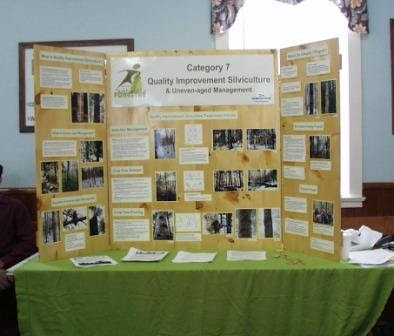
Patricia Amero of Picea Forestry Consulting presented a report on the Uneven-Aged Management Outreach Project that Picea is doing together with the NSWOOA. She summarized the features of the program, and outlined accomplishments to date. The project seems to be going very well and is on schedule. There are already about 250 woodlot owners in the database and more taking the survey every day. Read about the educational sessions below. Space is limited and pre-registration is required, so get in touch with the Outreach Project soon if you want to attend.

Above, NSWOOA Director Austin Parsons takes notes during his presentation on the Board's proposed submission to Voluntary Planning.
Director Austin Parsons presented the Board's proposed Voluntary Planning submission. It was in four parts. The first discussed forest diversity and healthy ecosystems as the basis of a diversified forest product industry. Diversity means sustainability and flexibility, whereas one product means rigidity and lack of sustainability. The second part dealt with the need for simplification and standardization in the industry. It would be much easier if all mills described their specifications in the same terms, and used the same criteria and paperwork for their Registered Buyer funds. The third section dealt with viewing woodlot owners as entrepreneurs who manage legitimate businesses. How can the business owners gain control of the resource? The final section was the recommendations and actions needed to bring about desired change.
Comments were vigorous and extremely helpful to the Board for their final revision. The presentation drew many compliments from those attending.
Lunch was followed by a lively panel discussion of "Hot Topics" such as Acadian Forest Restoration, biomass production, and global climate change. Below, NSWOOA President Lorne Burrows and Past President Tom Miller were among those who spoke during this discussion.
 Lorne Burrows
 Tom Miller
Cause to Celebrate
Three new directors were chosen for the NSWOOA board at the AGM: Tony Phillips, Sandy Hyde, and Kermit DeGooyer. Congratulations and welcome aboard.
Category 7 Outreach Project
Our Uneven-Aged Management Outreach Project will be conducting workshops and field trips throughout the province in May and June.
Focused on selection management, crop tree release, and crop tree pruning (silviculture methods that help woodlot owners to grow high-value trees), these free workshops are scheduled as follows:
• May 3, Digby County, Richfield area
• May 10, Colchester County, Earltown area
• May 24, Queens County, North Brookfield area
• June 7, Victoria County, Middle River area
• June 14, Antigonish County, St. Joseph area
• May 3, Digby County, Richfield area
• May 10, Colchester County, Earltown area
• May 24, Queens County, North Brookfield area
• June 7, Victoria County, Middle River area
• June 14, Antigonish County, St. Joseph area
Space for the Uneven-Aged Management Project workshops is limited, and pre-registration is required. To register, please call 902-673-2278 or email outreach@asforestry.com
Old Fields
An excerpt from Jamie Simpson's new book Restoring the Acadian Forest, p. 93. Used with permission.
An excerpt from Jamie Simpson's new book Restoring the Acadian Forest, p. 93. Used with permission.
Years of agricultural use typically have changed the soil composition and structure of [old fields]…. Some sites have a soil condition known as hardpan, caused by decades of ploughing to the same depth and which limits proper drainage and rooting. Course woody debris and, in some cases, nutrients and organic soil matter are even lower than in recent clearcuts. Plants common in abandoned fields—known as pioneer species—are able to withstand poor conditions, so they play an important role in rejuvenating such sites. With time, fields that are not mowed will eventually fill with pioneer species. The early successional plants protect the soil from erosion, add nutrients, and build organic matter. They also add shade and increase moisture levels, creating suitable microclimates for later-successional species and providing food and nesting sites for wildlife. Many of the pioneer trees grow fast and haverelatively short lives, so they provide a relatively quick source of standing and fallen deadwood. White spruce is a common component in this succession, along with species such as tamarack, white birch, poplar, cherry, alder and willow.
Lines of Communication
Members are encouraged to contact the Board of Directors, the Executive and other members through our email address (nswooa@gmail.com) or by phone (902-633-2108 or, for member services, 902-673-3009). Please feel free to use these methods to keep us informed of what is going on in your woodlot or in your community or area. We try to keep you informed through these updates, newsletters and mail outs, our column in Atlantic Forestry Review, the Annual General Meeting, and this website.
NSWOOA Update 12: March 2008

Above, the NSWOOA Board of Directors gathered recently to plan our April 12 Annual General Meeting. From left to right: NSWOOA Secretary Paul Brison, Vice President Ken MacRury, Barbara Gallagher, Jack McLellan (not visible), Treasurer Greg Amon, Charlie Baird, President Lorne Burrows, and Minga O’Brien. Board members not shown: Dave Parker, Austin Parsons, and Gerald Romsa.
Hello Woodlot Owners!
Here's a question for you: Why do you belong to an association, club or organization? What makes you join up and renew your membership? To put it another way, suppose you were selling a membership in the NSWOOA to your neighbor: What would he or she get in return for joining?
Probably you would point out that the NSWOOA represents woodlot owners on boards and committees at the local and provincial levels, that the NSWOOA has ties and possibly sway with other organizations that can work for you. Of course the NSWOOA has a long history of accomplishments and quite a bit of expertise on woodlot policy and management. Of course you could trot out the maxim that as a group, you have much more influence than as an individual. And then there are the field days and demonstration sites.
But have you included the opportunity to go to meetings? No, this is not sarcasm or even irony. As a member of the NSWOOA, you have the opportunity to attend meetings, especially the Annual General Meeting, to be updated on our work, learn from fellow woodlot owners, and have your input on topics of interest. At this year's AGM on April 12, we will have an update on the Uneven-Aged Management Outreach Project, a chance to fill out surveys that will be the basis of a report that will influence forest policy for years to come, and time to discuss thermal biomass harvesting/market, FSC regulation changes, and a proposed submission to the Voluntary Planning Forest Policy Review Panel.
There you have it: Join up and go to the event!
Tentative Agenda 2008 AGM
8:30 Registration
9:00 Housekeeping, welcome, President's address and welcome
9:10 Business Meeting
- Minutes from 2007 AGM
- Business arising
- Financial reports
- New business
- Resolutions from the floor
- Other
- Election of Directors
10:15 Coffee Break
10:45 Voluntary Planning Discussion
12:00 (12:15) Dinner
1:00 Discussion of "Hot Topics": Biomass, FSC, Other
Annual General Meeting Information
Where: Masonic Hall, Great Village
When: April 12, 8:30 AM
Cost: $20 Registration includes meal
Other: Memberships and membership renewals available at the meeting
Time to renew
NSWOOA memberships are by the calendar year, so if you have not renewed recently your membership may well have expired. Membership coordinator Flora Johnson will shortly be sending out renewal notices to former members who have not renewed for 2008. In the meantime, click here to find the information we need from you if you would like to join or renew by mail. Mail it with your cheque to the address provided. But better yet, bring it with you to the AGM!
Borealization
By Jamie Simpson, from the book Restoring the Acadian Forest.
Borealization is a term given by some to describe the increasing abundance in the Acadian Forest of tree species common to the Boreal Forest. These species are exposure-resistant trees such as poplar species, white birch, black spruce, jack pine and balsam fir, all of which are well adapted to frequent, large scale disturbances that are common in the Boreal Forest. Borealization of the Acadian Forest reduces the ecological resilience of the forest by making it more susceptible to large scale disturbances such as diseases, windstorms and insect infestation, a risky trend in the face of climate change. (p. 18)
Question: What are the driving factors of borealization?
Uneven-Aged Management Outreach Project
By Flora Johnson, NSWOOA Membership Services Coordinator
Looking for information on uneven-aged management or the Category 7 Quality Improvement Silviculture Program? Just look at the left side of this page. There you'll find links to our information package and reference list. Below that, you'll find links to articles and sources of information on uneven-aged management.
Interested in attending one of our free workshops? As a visitor to the NSWOOA website, you have an opportunity to pre-register for one of these programs before they are officially announced to the public.
Each program will begin with a morning workshop that will include both presentations and group discussion. This will be followed by an opportunity to visit a woodlot that has qualified for funding under the provincial funding program. There you will be able to see these treatments "on the ground" and have a chance to talk with the woodlot owner and/or contractor about the work and challenges involved in this approach.
Space in these programs is limited, so we encourage you to pre-register as soon as possible. Call 902-673-2278 or email nswooa@gmail.com
The programs are planned as follows:
- May 3 : Digby County, Richfield area
- May 10: Colchester County, Earltown area
- May 24: Queens County, North and South Brookfield area
- June 7: Victoria County, Middle River area.
- June 14: Antigonish County, St. Joseph area.
Lines of Communication
Members are encouraged to contact the Board of Directors, the Executive and other members through our email address (nswooa@gmail.com) or by phone (902-633-2108 or, for member services, 902-673-3009). Please feel free to use these methods to keep us informed of what is going on in your woodlot, in your community or area. We try to keep you informed through these updates, newsletters and mail outs, our column in Atlantic Forestry Review, the Annual General Meeting and this website.
NSWOOA Update 11: February 2008
Hello Woodlot Owners!
There's No End to It! Responsibility , that is. There is no end to responsibility for woodlot owners. There you have it; it's been said, straight out. Besides all our usual responsibilities, woodlot owners now have an additional one.
The new responsibility is to voice our vision of what forest policy and practices should be in Nova Scotia in the future to the review of natural resources policy being conducted by Voluntary Planning. Previously reviews were conducted by DNR itself, and while there were opportunities for woodlot owners and citizens at large to make presentations and submissions, the knock is that these inputs were then almost completely ignored when DNR consulted industry and made its final policies and regulations.
Under pressure from the NSWOOA and many other groups and individuals, the Government of Nova Scotia has opened up its review by asking a third party, the Voluntary Planning organization, to conduct the review and to be involved in distilling the input from the public, woodlot owners and industry into recommendations for the government to consider.
This is where our responsibility as woodlot owners comes in. Individually and through our organizations, we have the responsibility to make presentations and submissions to this Voluntary Planning panel.
Hearing a vision or recommendation once is not enough for such a panel to think it important, no matter how valid, utile or insightful it is. Hearing a chorus of similar views and concerns does influence the end results. A veritable groundswell of voices repeating and stressing these views and recommendations will demand inclusion in the final product.
The NSWOOA is preparing its vision of the new forestry with the values, policies and regulations that we feel should be in the final recommendations. As individual woodlot owners you have not only the opportunity but—some would say—the duty to make your individual ideas known. They reinforce each other. Hopefully every woodlot owner can have an impact by making a presentation directly or having input to a woodlot owners' group that is making a presentation.
Here is a partial list of topics on which woodlot owners might give advice for policy development:
You are encouraged to make every effort to put forward your ideas to the review process.
Annual General Meeting News: Some Changes
The NSWOOA's Annual General Meeting, to be held on April 12 in Great Village, will have the title "Hot Topics of 2008-2009." Among topics to be addressed is the presentation the NSWOOA will be making to Voluntary Plannin, as described above. We are now preparing recommendations that will be presented to our Annual General Meeting for discussion and possible adoption.
In addition, we expect to have presentations and discussion on issues such as biomass and the recent FSC certification of the former StoraEnso mill in Port Hawkesbury, which now belongs to NewPage Corporation. Members will also hear an update on the Uneven-Aged Management Outreach Project, which is described below.
This is an important meeting, and we hope all members will want to attend in order to learn about these topics, join the discussion, and participate in the business meeting as well.
Registration will begin at 8:30 am with the business meeting to start at 9 am. The program will last until 2:30 pm with breaks for coffee and lunch. Registration is $20 per person, which includes lunch. The program will be held in the Masonic Hall, 30 Station Road, Great Village.
Take our survey and have a chance to win a prize
The NSWOOA has begun work on an exciting new campaign to promote uneven-aged management techniques among woodlot owners and contractors. The Uneven-Aged Management Outreach Project now has a telephone number (902-673-2278) and email address (outreach@asforestry.com). We hope all woodlot owners and contractors who are interested in uneven-aged management or the Category 7 Quality Improvement Silviculture Program, which provides funding for treatments associated with uneven-aged management, will call or email us so that you can receive our packet of information materials and be notified of upcoming educational sessions.I
f you call the outreach number, you'll be asked if you want to take a survey. Please help us make sure we collect information from as many woodlot owners and contractors as possible, particularly ones with an interest in uneven-aged management. Everyone who takes the survey will be entered in a prize drawing to be held in September, and we have some great prizes lined up.
Also in the planning stages are workshops and field days to be held all over the province. Be sure to get on our mailing list in order to get an invitation to one of these meetings.
The Uneven-Aged Management Outreach Project is being conducted by NSWOOA under a contract with the Association for Sustainable Forestry and is funded by the Nova Scotia Department of Natural Resources. Our partner in delivering services under the contract is Picea Forestry Consulting and Woodlot Management of Bridgewater, NS. Information about the project will be posted both at the NSWOOA website and at the ASF website, http://www.asforestry.com/Category7program.htm
A Membership Benefit
Any NSWOOA member attending the April 12 meeting is encouraged to set up a display booth for any timber or nontimber product or service provided. Of course you can provide business cards and fliers for those in attendance, whether you have a display or not.
Some Thoughts on Forest Biodiversity
The following is an excerpt from Jamie Simpson's new Restoring the Acadian Forest: A Guide for Woodlot Owners in the Maritimes (p.55). Keep your eyes open for this excellent book when it comes out for sale.
So, what provisions have you made for genetic diversity on your woodlot? Let us know if you have had any interesting and successful projects to encourage genetic diversity.
Changes in Forestry Ownership and Their Possible Impact on Forestry and the Environment
By Director Gerald Romsa
There are some data appearing in the literature that ownership of large blocks of Forest Land (five thousand acres plus) in the NE United States (Northern New York, Vermont, New Hampshire and Maine) has shifted from forestry oriented owners to non forestry owners. In Maine by 2005 around 40 % of the forest land was owned by enterprises which have short term (10 year) business horizons. Land is treated by a new breed of landowners as a commodity to be sold for the highest price in the real estate or other markets. Forestry and environment groups are becoming quite concerned. Such changes are leading to less predictability in the future of the forest and in biodiversity practices. Many present forestry and related conservation practices are not fully applicable to this shift in ownership patterns. The new owners can argue they are not involved in the forestry sector. The question is, how does one mitigate potential downsides and maintain the forestry and environmental sectors in the face of changing interests of new forestry owners. In the North Eastern forests mentioned above some approaches have been to purchase large tracts of environmentally sensitive and genetically desirable tracts by having the new owners sell the desired parcels at the average selling price to conservation groups.
We need to examine the question of form of land ownership and its impact on Forest Policy.
Is there a pattern of forestry areas being bought up (1000 acres or larger) by owners whose interests are not primarily forestry related? If so are these owners from the Maritimes or elsewhere?
Invitation to a CAPE Meeting
CAPE (Citizen Action to Protect the Environment) invites the public to a presentation, "Forests for Life", on Thursday, February 28, 7:00 pm, at the Dr. Arthur Hines School in Summerville, Hants County. Concerned about clear-cuts? Worried about more herbicide spraying near your land? Wondering what forest management has to do with climate change and what you can do to help? Come and hear from the Ecology Action Centre's Standing Tall: Forests for Life Campaign. This hardhitting presentation gives you the facts about forestry in Nova Scotia --and suggests how we can achieve real changes that will preserve and protect our woodlands, water, and wildlife. Between April and June of this year, consultations will be held around Nova Scotia through a process called Voluntary Planning to find out what we think should be part of a new 10-year Natural Resources Strategy. Come and learn the different ways that you can have your say at these consultations and help determine what is done about forestry, mining, parks, and biodiversity in N.S. You can have your say about what happens in our forests, and help address the issue of climate change. Refreshments. Storm date is Tues., March 4. For more info, call Barbara at 633-2513, Merton at 633-2086, or Marilyn at 633-2051.
Lines of Communication
Members are encouraged to contact the Board of Directors, the Executive and other members through our email address or by phone (902-633-2108 or, for member services, 902-673-2278). Please feel free to use these methods to keep us informed of what is going on in your woodlot, in your community or area. We try to keep you informed through these updates, newsletters and mail outs, our column in Atlantic Forestry Review, the Annual General Meeting and this website.
There's No End to It! Responsibility , that is. There is no end to responsibility for woodlot owners. There you have it; it's been said, straight out. Besides all our usual responsibilities, woodlot owners now have an additional one.
The new responsibility is to voice our vision of what forest policy and practices should be in Nova Scotia in the future to the review of natural resources policy being conducted by Voluntary Planning. Previously reviews were conducted by DNR itself, and while there were opportunities for woodlot owners and citizens at large to make presentations and submissions, the knock is that these inputs were then almost completely ignored when DNR consulted industry and made its final policies and regulations.
Under pressure from the NSWOOA and many other groups and individuals, the Government of Nova Scotia has opened up its review by asking a third party, the Voluntary Planning organization, to conduct the review and to be involved in distilling the input from the public, woodlot owners and industry into recommendations for the government to consider.
This is where our responsibility as woodlot owners comes in. Individually and through our organizations, we have the responsibility to make presentations and submissions to this Voluntary Planning panel.
Hearing a vision or recommendation once is not enough for such a panel to think it important, no matter how valid, utile or insightful it is. Hearing a chorus of similar views and concerns does influence the end results. A veritable groundswell of voices repeating and stressing these views and recommendations will demand inclusion in the final product.
The NSWOOA is preparing its vision of the new forestry with the values, policies and regulations that we feel should be in the final recommendations. As individual woodlot owners you have not only the opportunity but—some would say—the duty to make your individual ideas known. They reinforce each other. Hopefully every woodlot owner can have an impact by making a presentation directly or having input to a woodlot owners' group that is making a presentation.
Here is a partial list of topics on which woodlot owners might give advice for policy development:
- Property rights
- The need for contractors who will harvest wood by methods other than clearcutting·
- Herbicide spraying
- Using wood to generate electricity or bio fuels
- Hardwood management
- Whole-tree harvesting
- The need for value-added industries
- Niche markets
- Biodiversity
- Wildlife protection
- Changing the structure of the forest industry
- Riparian zones
- Rural development
- Marketing systems
- Silviculture assistance
- Availability of seedlings
- Acadian Forest restoration
- Management plans
- Technical standards for silviculture
- Subsidies to large corporations
- Clearcutting restrictions
- Enforcement of environmental protection regulations
- Carbon credits
- Dedicating more funds for Category 7 Uneven Age Management
- Species utilization
- Exporting raw material
You are encouraged to make every effort to put forward your ideas to the review process.
Annual General Meeting News: Some Changes
The NSWOOA's Annual General Meeting, to be held on April 12 in Great Village, will have the title "Hot Topics of 2008-2009." Among topics to be addressed is the presentation the NSWOOA will be making to Voluntary Plannin, as described above. We are now preparing recommendations that will be presented to our Annual General Meeting for discussion and possible adoption.
In addition, we expect to have presentations and discussion on issues such as biomass and the recent FSC certification of the former StoraEnso mill in Port Hawkesbury, which now belongs to NewPage Corporation. Members will also hear an update on the Uneven-Aged Management Outreach Project, which is described below.
This is an important meeting, and we hope all members will want to attend in order to learn about these topics, join the discussion, and participate in the business meeting as well.
Registration will begin at 8:30 am with the business meeting to start at 9 am. The program will last until 2:30 pm with breaks for coffee and lunch. Registration is $20 per person, which includes lunch. The program will be held in the Masonic Hall, 30 Station Road, Great Village.
Take our survey and have a chance to win a prize
The NSWOOA has begun work on an exciting new campaign to promote uneven-aged management techniques among woodlot owners and contractors. The Uneven-Aged Management Outreach Project now has a telephone number (902-673-2278) and email address (outreach@asforestry.com). We hope all woodlot owners and contractors who are interested in uneven-aged management or the Category 7 Quality Improvement Silviculture Program, which provides funding for treatments associated with uneven-aged management, will call or email us so that you can receive our packet of information materials and be notified of upcoming educational sessions.I
f you call the outreach number, you'll be asked if you want to take a survey. Please help us make sure we collect information from as many woodlot owners and contractors as possible, particularly ones with an interest in uneven-aged management. Everyone who takes the survey will be entered in a prize drawing to be held in September, and we have some great prizes lined up.
Also in the planning stages are workshops and field days to be held all over the province. Be sure to get on our mailing list in order to get an invitation to one of these meetings.
The Uneven-Aged Management Outreach Project is being conducted by NSWOOA under a contract with the Association for Sustainable Forestry and is funded by the Nova Scotia Department of Natural Resources. Our partner in delivering services under the contract is Picea Forestry Consulting and Woodlot Management of Bridgewater, NS. Information about the project will be posted both at the NSWOOA website and at the ASF website, http://www.asforestry.com/Category7program.htm
A Membership Benefit
Any NSWOOA member attending the April 12 meeting is encouraged to set up a display booth for any timber or nontimber product or service provided. Of course you can provide business cards and fliers for those in attendance, whether you have a display or not.
Some Thoughts on Forest Biodiversity
The following is an excerpt from Jamie Simpson's new Restoring the Acadian Forest: A Guide for Woodlot Owners in the Maritimes (p.55). Keep your eyes open for this excellent book when it comes out for sale.
Genetic diversity is not a common topic of discussion of woodlot
management. Nonetheless, its importance to forest health is immense. Sufficient
genetic diversity means there are enough individual differences within a species
that it has a chance to adapt to a constantly changing world, where failure to
adapt means failure to survive. … In making decisions about tree cutting and
planting, woodlot owners collectively help to shape the genetic diversity of the
Acadian Forest system. …
These little differences within each individual are important. Combined
they are a storehouse of 'possibilities' that can allow a population to respond
over many generations, to changes in the environment. So long as there is
sufficient genetic diversity, some individuals will have the traits necessary to
survive environmental changes and will pass these traits onto the next
generation. (Used with permission).
So, what provisions have you made for genetic diversity on your woodlot? Let us know if you have had any interesting and successful projects to encourage genetic diversity.
Changes in Forestry Ownership and Their Possible Impact on Forestry and the Environment
By Director Gerald Romsa
There are some data appearing in the literature that ownership of large blocks of Forest Land (five thousand acres plus) in the NE United States (Northern New York, Vermont, New Hampshire and Maine) has shifted from forestry oriented owners to non forestry owners. In Maine by 2005 around 40 % of the forest land was owned by enterprises which have short term (10 year) business horizons. Land is treated by a new breed of landowners as a commodity to be sold for the highest price in the real estate or other markets. Forestry and environment groups are becoming quite concerned. Such changes are leading to less predictability in the future of the forest and in biodiversity practices. Many present forestry and related conservation practices are not fully applicable to this shift in ownership patterns. The new owners can argue they are not involved in the forestry sector. The question is, how does one mitigate potential downsides and maintain the forestry and environmental sectors in the face of changing interests of new forestry owners. In the North Eastern forests mentioned above some approaches have been to purchase large tracts of environmentally sensitive and genetically desirable tracts by having the new owners sell the desired parcels at the average selling price to conservation groups.
We need to examine the question of form of land ownership and its impact on Forest Policy.
Is there a pattern of forestry areas being bought up (1000 acres or larger) by owners whose interests are not primarily forestry related? If so are these owners from the Maritimes or elsewhere?
- What is their commitment to an environmentally sustainable forestry?
- Will present or proposed forestry policies work if forest areas are owned by non forestry interested owners whose desire for income arises from non forestry practices?
- What could such changing land ownership practices do to an environmentally sustainable forestry and to environmentally and biologically sensitive, threatened and unique areas?
- What could such changes in forest ownership do to the evolution of a carbon neutral society?
- How does Nova Scotia protect the Forest, the environment and threatened and unique habitats from changes in forest ownership or land owners philosophy?
- Require new owners of larger blocks of forest land to sell to the Province or Conservation groups a portion of the land for the average price they paid?
- Is it feasible to use an urban planning approach that requires owners proposing a new land use/management policy to donate a portion of their land to the public (Province/County/Municipality/Conservation-Environment Group)?
Invitation to a CAPE Meeting
CAPE (Citizen Action to Protect the Environment) invites the public to a presentation, "Forests for Life", on Thursday, February 28, 7:00 pm, at the Dr. Arthur Hines School in Summerville, Hants County. Concerned about clear-cuts? Worried about more herbicide spraying near your land? Wondering what forest management has to do with climate change and what you can do to help? Come and hear from the Ecology Action Centre's Standing Tall: Forests for Life Campaign. This hardhitting presentation gives you the facts about forestry in Nova Scotia --and suggests how we can achieve real changes that will preserve and protect our woodlands, water, and wildlife. Between April and June of this year, consultations will be held around Nova Scotia through a process called Voluntary Planning to find out what we think should be part of a new 10-year Natural Resources Strategy. Come and learn the different ways that you can have your say at these consultations and help determine what is done about forestry, mining, parks, and biodiversity in N.S. You can have your say about what happens in our forests, and help address the issue of climate change. Refreshments. Storm date is Tues., March 4. For more info, call Barbara at 633-2513, Merton at 633-2086, or Marilyn at 633-2051.
Lines of Communication
Members are encouraged to contact the Board of Directors, the Executive and other members through our email address or by phone (902-633-2108 or, for member services, 902-673-2278). Please feel free to use these methods to keep us informed of what is going on in your woodlot, in your community or area. We try to keep you informed through these updates, newsletters and mail outs, our column in Atlantic Forestry Review, the Annual General Meeting and this website.
NSWOOA Update 10: January 2008
Hello Woodlot Owners!
Picture this: It was a warm sunny day in early hunting season in, probably, the mid eighties. Twenty-eight "townie" teenagers were following Maurice Bruhm and their grade 11 Economics teacher around Maurice's sawmill in Cornwall, Lunenburg County, and then on a tour of his woodlot. In their hands, the kids carried a sheet of questions which would elicit information from their guide and provide the substance of their field trip report.
For those of you who knew Maurice Bruhm, it will not be hard to conjure up his thick Lunenburg County "Dutch" accent, or his quiet, thoughtful way of speaking. In fact, Maurice spoke so quietly and unassumingly that the visitors had to be very still and to listen intently to catch his words.
At one spot, Maurice stopped by some flagging tape tied to some shrubs. No one knew what the plant was. "Labrador Tea," said Maurice. "I don't know what to do about it. It was pointed out to me that it was there, so I marked it to keep it from being destroyed. We tend to destroy things if we don't know they are there. So I marked them." Such were his lessons.
At the next stop, Maurice showed the students a particularly fertile area, a ridge of good soil that grew trees very well. He explained that he had harvested trees there a number of times in his life time, and his father had before him, and that there was as much wood on this land now as there had ever been. This was his lesson in selective harvesting.
The third stop was another stand of mostly conifers, about six to seven inches in diameter. Without even the hint of a smile he quietly stated that he was going to wait until there was 100 board feet of lumber in each tree before he cut them and milled them. There were no comments from the students, as they jotted this information on their fact sheets.
Later, when questioned alone about his bold statement, Maurice claimed that he couldn't resist testing to see if the youngsters understood the concepts he was getting at. And, it seems, he was enjoying his joke on them. Youth seldom has a sense of the passage of time that comes with working with the forest. He smiled at it all.
Sadly, Maurice passed away a few years later, a great loss to his family and the community. As for his visitors, doubtless their lessons that day have informed them of forest management issues thereafter. More of our youth should have the opportunity to be guided by the Maurice Bruhms of this province.
You Are Invited…
On Tuesday January 22 at 7:00 pm there will be a meeting of interested directors and NSWOOA members at the Community Room in Elmsdale Superstore.
The purpose of this meeting is to decide upon the content, form and vision of the NSWOOA's presentation to Voluntary Planning's Natural Resources Strategy Project Committee, which is going to make recommendations for a long-term strategy for provincial forests, biodiversity, and other natural resources. (For more information about this process see the Voluntary Planning website .) The NSWOOA was one of several organizations that called on the provincial government to put Voluntary Planning in charge of developing a new natural resources strategy. It is expected that the session on January 22 will produce a document that will be presented to our Annual General Meeting for discussion and possible adoption.
This is a very important issue and opportunity. Please make an effort to attend.
Uneven-Aged Management Outreach Project
By Flora Johnson, NSWOOA Member Services Coordinator
As many of you already know, we have begun work on an exciting new campaign to promote uneven-aged management techniques among woodlot owners and contractors. The Uneven-Aged Management Outreach Project now has a telephone number (902-673-2278) and email address (outreach@asforestry.com) . We hope all NSWOOA members will call or email us so that you can receive our packet of information materials and be notified of upcoming educational sessions.
Please note that the Outreach Project telephone number given in the last update unfortunately had to be changed after the update was sent. If you called that number and did not receive an answer, please try us again at 673-2278. We apologize for the inconvenience.
Outreach Project staff are putting the finishing touches on a survey that we hope to administer to woodlot owners and contractors who contact us. Please help us make sure we collect information from as many woodlot owners and contractors as possible, particularly ones with an interest in uneven-aged management. Just email me at the outreach@asforestry.com, and I'll be happy to either send you a copy of the survey via email or call you and ask you the questions in person.
Also in the planning stages are workshops and field days to be held all over the province. Stay tuned for updates about these as they are planned.
The Uneven-Aged Management Outreach Project is being conducted by NSWOOA under a contract with the Association for Sustainable Forestry with funding from the Nova Scotia Department of Natural Resources. Our partner in delivering services under the contract is Picea Forestry Consulting and Woodlot Management of Bridgewater, NS. I would like to express my personal thanks to Patricia Amero, Registered Professional Forester and one of the owners of Picea, for her hard work and dedication to this project.
AGM Planning Has Begun
At the January 10 Directors meeting, the initial planning for this year's AGM began with the decision to hold the meeting in the Elmsdale area on Saturday, April 12. Decisions are tentative at this stage, but the character of the event is taking shape.
The overall theme is value woodlot products and value added wood products (as opposed to large quantities of low valued products). Of course there will also be the business meeting and such to be done.
Morning events will probably include a presentation on the Category 7 Outreach Project and a presentation/discussion of our forestry practice submission to the Voluntary Planning review of provincial natural resources policy. Be sure to be there to have your input heard.
The afternoon will probably see a tour of a sawmill, with the opportunity to ask questions of the mill managers, wood buyers and so on.
Depending on the size of the facility chosen for the meeting, booths may be available for members and others to display their products and advertise services. If you are interested please contact us at nswooa@gmail.com so that we may gauge interest. As well, we invite members to supply business cards and pamphlets for those attending to pick up at the registration desk.
As mentioned, plans are only tentative at this point, but the meeting seems to be shaping up to be a really valuable event to attend. Stay tuned for additional information—times, locations, etc. Information will be posted on this website, and you will receive a notice about the meeting along with a request to renew your membership if you haven't already.
Membership Renewals
Please remember that membership fees are our main source of income, and this is renewal season. Memberships go with the calendar year, and almost every one of us has to renew for 2008. If you have friends or neighbors who are interested in the issues and concerns that we deal with please invite them to join our ranks. You should soon receive a renewal notice from Flora, our membership coordinator, by email or by regular mail. Flora will also be sending a renewal form with the newsletter/notice of meeting for the AGM, for those who have not yet paid.
Membership renewal forms can be mailed in directly. We will also accept memberships at the Annual General Meeting on April 12.
An Interesting Request
Director Austin Parsons, who teaches architecture, has received the following request from a student, and passes it along to us: "I was wondering if you could direct me to a directory of sustainable woodlots in the province--specifically in Colchester County. I've been hunting around on the internet but am not coming up with much."
Austin explains that he does not know of any directory, or for that matter, if anyone has an agreed upon definition of a sustainable woodlot. He remembered that Kim Thompson had compiled the Eastern Shore Wood Directory, but not much more came to mind.
It seems that there is a need for various directories around the province, as we often get queries from woodlot owners and others for a directory of FSC products, of portable sawmills, of particular products, of horse loggers, of silviculture contractors, and, of course, contractors who will do multi-age multi-species harvesting.
The Standing Tall Campaign for Environmentally Responsible Forestry has compiled a list of woodlot owners supplying FSC-certified wood. If any members out there have knowledge of a directory that would be of use to Austin's student, or other directories that cover any of the other categories, please advise us by email. We will pass the information along. Perhaps we could compile a directory of directories.
Conservation of Working Land
Note: There has been interest lately in conservation easements attached to lands, or other methods by which owners can protect their forest land from practices they deem unfit, after they are deceased. There are a variety of methods and institutions available, and some are more suitable in some instances than others. Jennifer Scott's article below details one method. Hopefully we will receive details on other methods and pass them along as well. Incidentally, Rupert Jannasch, cited below, is a NSWOOA member.
Two Nova Scotia farms protected by conservation easements
By Jen Scott
Working land is land that is worked to produce food or forest products. This kind of land might be worth protecting because it is important for food production, it contributes to biodiversity, it has been well taken care of for generations, or it has valuable woodland that should not be clearcut. The land might be threatened by urban sprawl, or by economic conditions that would make it tempting for the landowner to sell off parcels, or clearcut the woodlot.
How can we protect important working land? One way is to use a conservation easement--a legal document that is attached to the deed, placing restrictions on the use of the land even if the property is sold. The easement is negotiated with the landowner, then registered with the province. A designated "eligible body" takes on the responsibility of ensuring the landowner adheres to the terms.
The Ecology Action Centre (EAC), based in Halifax, has been added to the Eligible Body list under Nova Scotia's Conservation Easement Act. Through its agriculture-oriented sub-group called Heliotrust, the EAC now holds easements with two farms in Hants County: Avonmouth Farm and Red Fox Co-op. EAC does not own the farms, but as the easement holder, it has an interest in ensuring the 300 acres are managed in an ecological manner, according to the terms of the agreements. To that end, a community-based monitoring system will be developed.
These two conservation easements are structured to protect the farm and woodland from subdivision and development, but they are for "working" land, as opposed to "wild" land. This is an important distinction, as it recognizes the stewardship responsibility of the farmer. The land must be managed in an ecological manner, no matter who owns it.
In signing the conservation easement, the farmer gives up some of the real estate value of the farmland, because it cannot be sold for non-farm purposes. This makes the land more affordable for the next person who wants to purchase it for farming.
The real estate value of a farm is a function of what people would be willing to pay for it. This makes farms closest to urban centers, and those with particularly beautiful attributes, the most vulnerable to speculative hikes in value. Theoretically, the value of the conservation easement is roughly equivalent to the difference between the market value of the land and its productive value as a working farm. In negotiating what it would pay the owners of Avonmouth Farm and Red Fox Co-op, the EAC obtained independent appraisals from a farm economist and a real estate professional.
Both farms have woodlots, but woodlands on Avonmouth Farm are a significant part of the farm operation. Rupert Jannasch took over Avonmouth in 2003, and has been developing various horticultural and forestry enterprises. He says he is pleased with the easement agreement, but he points out that an agricultural landowner who trades away development rights is assuming a degree of risk. "Consider a scenario in the future when a landowner, a farmer, no longer wishes to or is unable to farm," says Jannasch. "He still owns the land, but sold a conservation easement 20 years earlier prohibiting other uses. No young farmers are waiting to fill his shoes. Perhaps new food safety regulations make it impossible to produce food, or there is no longer a willing labor force. . . . What does the landowner do?" Such uncertainties must be weighed against the benefits of protecting the land.
A government program or a larger charitable organization with significant financial resources would be able to achieve the same objective by purchasing agricultural acreage and leasing it to farmers, but in the near future there are no prospects for this in Nova Scotia. For now, the protection of farmland depends to a large extent on landowners' commitment to the principle.
Heliotrust has set up a special conservation fund, with the interest to be used for monitoring conserved land and covering any legal fees that may be necessary to ensure compliance with the terms of easements in the future. The EAC hopes to increase the fund in order to protect more working land. Charitable receipts are issued by EAC for donations. To contribute to the working land conservation effort, specify that the donation is for Heliotrust's farmland conservation fund.
News and updates from Heliotrust may be found at The Heliotrust Journal.
Lines of Communication
Members are encouraged to contact the Board of Directors, the Executive and other members through our email address or by phone (902-633-2108). Please feel free to use these methods to keep us informed of what is going on in your woodlot, in your community or area. We try to keep you informed through these updates, through newsletters and mail outs, our column in Atlantic Forestry Review, the Annual General Meeting and this website.
Picture this: It was a warm sunny day in early hunting season in, probably, the mid eighties. Twenty-eight "townie" teenagers were following Maurice Bruhm and their grade 11 Economics teacher around Maurice's sawmill in Cornwall, Lunenburg County, and then on a tour of his woodlot. In their hands, the kids carried a sheet of questions which would elicit information from their guide and provide the substance of their field trip report.
For those of you who knew Maurice Bruhm, it will not be hard to conjure up his thick Lunenburg County "Dutch" accent, or his quiet, thoughtful way of speaking. In fact, Maurice spoke so quietly and unassumingly that the visitors had to be very still and to listen intently to catch his words.
At one spot, Maurice stopped by some flagging tape tied to some shrubs. No one knew what the plant was. "Labrador Tea," said Maurice. "I don't know what to do about it. It was pointed out to me that it was there, so I marked it to keep it from being destroyed. We tend to destroy things if we don't know they are there. So I marked them." Such were his lessons.
At the next stop, Maurice showed the students a particularly fertile area, a ridge of good soil that grew trees very well. He explained that he had harvested trees there a number of times in his life time, and his father had before him, and that there was as much wood on this land now as there had ever been. This was his lesson in selective harvesting.
The third stop was another stand of mostly conifers, about six to seven inches in diameter. Without even the hint of a smile he quietly stated that he was going to wait until there was 100 board feet of lumber in each tree before he cut them and milled them. There were no comments from the students, as they jotted this information on their fact sheets.
Later, when questioned alone about his bold statement, Maurice claimed that he couldn't resist testing to see if the youngsters understood the concepts he was getting at. And, it seems, he was enjoying his joke on them. Youth seldom has a sense of the passage of time that comes with working with the forest. He smiled at it all.
Sadly, Maurice passed away a few years later, a great loss to his family and the community. As for his visitors, doubtless their lessons that day have informed them of forest management issues thereafter. More of our youth should have the opportunity to be guided by the Maurice Bruhms of this province.
You Are Invited…
On Tuesday January 22 at 7:00 pm there will be a meeting of interested directors and NSWOOA members at the Community Room in Elmsdale Superstore.
The purpose of this meeting is to decide upon the content, form and vision of the NSWOOA's presentation to Voluntary Planning's Natural Resources Strategy Project Committee, which is going to make recommendations for a long-term strategy for provincial forests, biodiversity, and other natural resources. (For more information about this process see the Voluntary Planning website .) The NSWOOA was one of several organizations that called on the provincial government to put Voluntary Planning in charge of developing a new natural resources strategy. It is expected that the session on January 22 will produce a document that will be presented to our Annual General Meeting for discussion and possible adoption.
This is a very important issue and opportunity. Please make an effort to attend.
Uneven-Aged Management Outreach Project
By Flora Johnson, NSWOOA Member Services Coordinator
As many of you already know, we have begun work on an exciting new campaign to promote uneven-aged management techniques among woodlot owners and contractors. The Uneven-Aged Management Outreach Project now has a telephone number (902-673-2278) and email address (outreach@asforestry.com) . We hope all NSWOOA members will call or email us so that you can receive our packet of information materials and be notified of upcoming educational sessions.
Please note that the Outreach Project telephone number given in the last update unfortunately had to be changed after the update was sent. If you called that number and did not receive an answer, please try us again at 673-2278. We apologize for the inconvenience.
Outreach Project staff are putting the finishing touches on a survey that we hope to administer to woodlot owners and contractors who contact us. Please help us make sure we collect information from as many woodlot owners and contractors as possible, particularly ones with an interest in uneven-aged management. Just email me at the outreach@asforestry.com, and I'll be happy to either send you a copy of the survey via email or call you and ask you the questions in person.
Also in the planning stages are workshops and field days to be held all over the province. Stay tuned for updates about these as they are planned.
The Uneven-Aged Management Outreach Project is being conducted by NSWOOA under a contract with the Association for Sustainable Forestry with funding from the Nova Scotia Department of Natural Resources. Our partner in delivering services under the contract is Picea Forestry Consulting and Woodlot Management of Bridgewater, NS. I would like to express my personal thanks to Patricia Amero, Registered Professional Forester and one of the owners of Picea, for her hard work and dedication to this project.
AGM Planning Has Begun
At the January 10 Directors meeting, the initial planning for this year's AGM began with the decision to hold the meeting in the Elmsdale area on Saturday, April 12. Decisions are tentative at this stage, but the character of the event is taking shape.
The overall theme is value woodlot products and value added wood products (as opposed to large quantities of low valued products). Of course there will also be the business meeting and such to be done.
Morning events will probably include a presentation on the Category 7 Outreach Project and a presentation/discussion of our forestry practice submission to the Voluntary Planning review of provincial natural resources policy. Be sure to be there to have your input heard.
The afternoon will probably see a tour of a sawmill, with the opportunity to ask questions of the mill managers, wood buyers and so on.
Depending on the size of the facility chosen for the meeting, booths may be available for members and others to display their products and advertise services. If you are interested please contact us at nswooa@gmail.com so that we may gauge interest. As well, we invite members to supply business cards and pamphlets for those attending to pick up at the registration desk.
As mentioned, plans are only tentative at this point, but the meeting seems to be shaping up to be a really valuable event to attend. Stay tuned for additional information—times, locations, etc. Information will be posted on this website, and you will receive a notice about the meeting along with a request to renew your membership if you haven't already.
Membership Renewals
Please remember that membership fees are our main source of income, and this is renewal season. Memberships go with the calendar year, and almost every one of us has to renew for 2008. If you have friends or neighbors who are interested in the issues and concerns that we deal with please invite them to join our ranks. You should soon receive a renewal notice from Flora, our membership coordinator, by email or by regular mail. Flora will also be sending a renewal form with the newsletter/notice of meeting for the AGM, for those who have not yet paid.
Membership renewal forms can be mailed in directly. We will also accept memberships at the Annual General Meeting on April 12.
An Interesting Request
Director Austin Parsons, who teaches architecture, has received the following request from a student, and passes it along to us: "I was wondering if you could direct me to a directory of sustainable woodlots in the province--specifically in Colchester County. I've been hunting around on the internet but am not coming up with much."
Austin explains that he does not know of any directory, or for that matter, if anyone has an agreed upon definition of a sustainable woodlot. He remembered that Kim Thompson had compiled the Eastern Shore Wood Directory, but not much more came to mind.
It seems that there is a need for various directories around the province, as we often get queries from woodlot owners and others for a directory of FSC products, of portable sawmills, of particular products, of horse loggers, of silviculture contractors, and, of course, contractors who will do multi-age multi-species harvesting.
The Standing Tall Campaign for Environmentally Responsible Forestry has compiled a list of woodlot owners supplying FSC-certified wood. If any members out there have knowledge of a directory that would be of use to Austin's student, or other directories that cover any of the other categories, please advise us by email. We will pass the information along. Perhaps we could compile a directory of directories.
Conservation of Working Land
Note: There has been interest lately in conservation easements attached to lands, or other methods by which owners can protect their forest land from practices they deem unfit, after they are deceased. There are a variety of methods and institutions available, and some are more suitable in some instances than others. Jennifer Scott's article below details one method. Hopefully we will receive details on other methods and pass them along as well. Incidentally, Rupert Jannasch, cited below, is a NSWOOA member.
Two Nova Scotia farms protected by conservation easements
By Jen Scott
Working land is land that is worked to produce food or forest products. This kind of land might be worth protecting because it is important for food production, it contributes to biodiversity, it has been well taken care of for generations, or it has valuable woodland that should not be clearcut. The land might be threatened by urban sprawl, or by economic conditions that would make it tempting for the landowner to sell off parcels, or clearcut the woodlot.
How can we protect important working land? One way is to use a conservation easement--a legal document that is attached to the deed, placing restrictions on the use of the land even if the property is sold. The easement is negotiated with the landowner, then registered with the province. A designated "eligible body" takes on the responsibility of ensuring the landowner adheres to the terms.
The Ecology Action Centre (EAC), based in Halifax, has been added to the Eligible Body list under Nova Scotia's Conservation Easement Act. Through its agriculture-oriented sub-group called Heliotrust, the EAC now holds easements with two farms in Hants County: Avonmouth Farm and Red Fox Co-op. EAC does not own the farms, but as the easement holder, it has an interest in ensuring the 300 acres are managed in an ecological manner, according to the terms of the agreements. To that end, a community-based monitoring system will be developed.
These two conservation easements are structured to protect the farm and woodland from subdivision and development, but they are for "working" land, as opposed to "wild" land. This is an important distinction, as it recognizes the stewardship responsibility of the farmer. The land must be managed in an ecological manner, no matter who owns it.
In signing the conservation easement, the farmer gives up some of the real estate value of the farmland, because it cannot be sold for non-farm purposes. This makes the land more affordable for the next person who wants to purchase it for farming.
The real estate value of a farm is a function of what people would be willing to pay for it. This makes farms closest to urban centers, and those with particularly beautiful attributes, the most vulnerable to speculative hikes in value. Theoretically, the value of the conservation easement is roughly equivalent to the difference between the market value of the land and its productive value as a working farm. In negotiating what it would pay the owners of Avonmouth Farm and Red Fox Co-op, the EAC obtained independent appraisals from a farm economist and a real estate professional.
Both farms have woodlots, but woodlands on Avonmouth Farm are a significant part of the farm operation. Rupert Jannasch took over Avonmouth in 2003, and has been developing various horticultural and forestry enterprises. He says he is pleased with the easement agreement, but he points out that an agricultural landowner who trades away development rights is assuming a degree of risk. "Consider a scenario in the future when a landowner, a farmer, no longer wishes to or is unable to farm," says Jannasch. "He still owns the land, but sold a conservation easement 20 years earlier prohibiting other uses. No young farmers are waiting to fill his shoes. Perhaps new food safety regulations make it impossible to produce food, or there is no longer a willing labor force. . . . What does the landowner do?" Such uncertainties must be weighed against the benefits of protecting the land.
A government program or a larger charitable organization with significant financial resources would be able to achieve the same objective by purchasing agricultural acreage and leasing it to farmers, but in the near future there are no prospects for this in Nova Scotia. For now, the protection of farmland depends to a large extent on landowners' commitment to the principle.
Heliotrust has set up a special conservation fund, with the interest to be used for monitoring conserved land and covering any legal fees that may be necessary to ensure compliance with the terms of easements in the future. The EAC hopes to increase the fund in order to protect more working land. Charitable receipts are issued by EAC for donations. To contribute to the working land conservation effort, specify that the donation is for Heliotrust's farmland conservation fund.
News and updates from Heliotrust may be found at The Heliotrust Journal.
Lines of Communication
Members are encouraged to contact the Board of Directors, the Executive and other members through our email address or by phone (902-633-2108). Please feel free to use these methods to keep us informed of what is going on in your woodlot, in your community or area. We try to keep you informed through these updates, through newsletters and mail outs, our column in Atlantic Forestry Review, the Annual General Meeting and this website.
Subscribe to:
Posts (Atom)