Showing posts with label outreach project. Show all posts

Update 18: November 2008

Hello Woodlot Owners!

The neighbor back on the hill made another visit the other night, and in the course of discussion made an observation—or was it an accusation: “I was back in your woods looking for you. The place’s a mess. You must be getting lazy.” The words stung, even if he had meant it in jest.
“What do you mean? There’s nothing wrong…”

But he had the evidence: “Some trees are cut and just laying there. Some trees that should be cut, aren’t. Deadfalls aren’t taken; brush isn’t piled up. Some places you cut out holes in the woods, and other places you didn’t cut trees that were big enough to take. There’s no pattern to it.”

OK, his meaning was becoming clear. The woods did not look tidy. A few more comments and it was clear that the site had not been cut the way he would have cut it. Or my father or grandfather either, apparently. He was right. And yes, the place was and is messy. There are open spots, to encourage regeneration. Some thickets have been left, for wildlife. Cavity trees were not harvested, and some trees had been left standing for no more reason than there were very few of that kind of tree on the lot. Coarse woody debris is strewn around. Seed trees have been left standing.

There is a strange thing that happens in the woods during harvest, because there are more factors than economic values telling the land owner what needs to be done. And more costs than just the cost of harvesting that have to be accounted for. After making slow, careful decision after decision about what is right to do with each tree, a kind of “feeling” for the forest develops. An understanding about what the forest needs, what it tolerates, what it likes, seems to settle upon the thinking harvester. And tidiness is not one of the forest’s needs.

Voluntary Planning

Three NSWOOA directors, including President Lorne Burrows, attended the Oct. 26 Voluntary Planning session workshop in Truro, to discuss and evaluate their report What We Heard, which is a look at major themes and perspectives distilled from comments and written submissions generated by their province-wide public meetings. Sixty people, including citizens, woodlot owners, activists, DNR types, mining industry reps and the various mills, attended. This was one of three such meetings designed to workshop five main themes: sustainability, balance, diversity, and transparency. No actual recommendations were discussed or points debated. And no weight was given to the themes, or numbers of respondents supporting each view, and so on. It was also not revealed how many meetings individuals or industries attended.

The next step is for a committee to review all the input data and Voluntary Planning’s synthesis of this data, to formulate recommendations. Composition of this committee is not known, or how one would achieve a seat on it, but in the interest of transparency—one of the VP themes—its meetings necessarily need to be open to the public, and its comments balanced to represent the proportion of individuals who attended from each of the types mentioned above. There are strong reasons to require this new board to keep DNR and Industry to a minority position on this committee. Confidence in the process seems much more shaky to many of the participants, and one wonders what will happen next.

Biomass and the NSWOOA

The NSWOOA announces that it has resigned its seat on the government’s biomass working group, charged with developing guidelines for biomass harvesting in Nova Scotia. Wade Prest, our representative on the group, announced his resignation, and the NSWOOA’s withdrawal from the process on October 20.

The NSWOOA will not be associated with any reports, rules or regulations produced by this group, and strongly urges those who continue with the process to conduct a review of existing research on biomass removal and forest health, to conduct research to see how it applies to the Nova Scotia situation and the Acadian Forest, and to apply the precautionary approach.

Outreach Project

The Uneven-Aged Management Outreach Project is coming to an end, but before closing up shop the Outreach Team has asked us to pass on some great news. Because of the outstanding response to the project, NSDNR allocated an additional $153,000 to funding under the Category 7 program, bringing the total funding available to almost $600,000. Some funding is still available for work to be completed by March, 2009, so if you have a site that would qualify, haven't already applied for funding, and are interested in doing some quality-improvement work this winter, please contact Association for Sustainable Forestry Coordinator Rebecca Aggas at (902) 890-4685 or rjaggas@ASForestry.com. Information on the program, including the Outreach Project’s 6-page handout on uneven-aged management and the Category 7 program, can still be downloaded from the ASF's website at http://www.asforestry.com/Category7program.htm

The Outreach Team also wants to thank NSWOOA members for your help in making this project a success. The Outreach Project was contacted by approximately 400 individuals and families. About 200 people attended the workshops. Newspapers, magazines and radio stations all over the province carried stories about the project, the Category 7 program and uneven-aged management. And allocations of Category 7 funding more than tripled, rising from $180,000 as of the end of 2007 to $575,000 as of late October 2008. Thanks to the information the project received from woodlot owners and contractors during the course, the team was able to submit a detailed report to the ASF and NSDNR emphasizing the tremendous interest and support for uneven-aged management among woodlot owners and forestry contractors throughout the province.

We hope that this report will encourage even more support for uneven-aged management—not only funding but also additional outreach activitiesin future years. None of this would have been possible without your interest and participation in this project.

Early Notice

At its November meeting, the NSWOOA Board of Directors has chosen the date and location for our Annual General Meeting. It is April 18th 2009, at the Masonic Hall in Great Village. If you have any suggestions for speakers or themes and activities, please forward them to us at our email address or to our contact phone number.

Balsam Fir

(Excerpted from Jamie Simpson’s book Restoring the Acadian Forest: A Guide for Woodlot Owners in the Maritimes, P41. The book is due to be published this month. Meanwhile, Jamie is taking orders for the book at this email address (price will be $20, including shipping.)

Balsam fir is far more abundant, dominant and wide-spread in the forest than it was a few generations ago.

Forest cutting practices often create conditions favorable to balsam fir. High-grade cutting removes species that grow with balsam fir, such as white pine, red spruce, hemlock, cedar and hardwoods….Clearcutting, too, promotes balsam fir by creating growing conditions in which the aggressive fir seedlings gain advantage over seedlings of other species. Balsam fir has rather large seed and fir seedlings have strong root systems that access water more easily than spruce seedlings do, giving balsam fir the advantage in the relatively dry conditions of a clear cut. Finally, because forests are often cut before they are ecologically mature, tree species that would normally gain dominance over balsam fir trees by simply outliving them are cut before they have a chance to grow old, further perpetuating balsam fir on harvested land.

Lines of Communication

Members are encouraged to contact the Board of Directors, the Executive and other members through our email address (nswooa@gmail.com) or by phone (902-633-2108). Please feel free to use these methods to keep us informed of what is going on in your woodlot or in your community or area. We try to keep you informed through these updates, mail outs, our column in Atlantic Forestry Review, the Annual General Meeting, and this website.

NSWOOA Update 17: October/November 2008

Hello Woodlot Owners!

Kudos

Demo 2008 afforded the chance to pick up DNR's Module 13 in the home study series: Non Timber Forest Products: Growing Opportunities. The whole series is worth reading, and for anyone new to forest management the modules can be a great assistance in getting up to speed in preparation to make decisions on your own woodlot.

The new module, by David Sutherland, takes a look at both consumptive and nonconsumptive NTFPs, as they are called. The module is straightforward, and covers a wide variety of products and opportunities. It is, of course, a well-illustrated survey of what is being done by some woodlot owners now and what might be done in the future to enhance the financial return from your woodlots. Thus, it does not get into some of the nitty-gritty of setting up businesses based on these products, but it does approach the issues with optimism and clarity.

Perhaps the best advice in the whole module comes in the early part of the book, page 7: "Now perhaps more than ever, natural products have an appeal to most people as they pursue healthier lifestyles. An endless array of products claiming to be 'all natural' are common on store shelves. Often the manufacturer's name implies a bond with the wild untamed world: 'frontier', 'Backwoods', 'wilderness', and 'Forest health' all appeal to the consumer. The seller of non timber forest products can add market value by using the right words."

He's right. A good many times it is not what you have to sell, it's what you call it that makes people want it. The lesson can be extended to even the name of your NTFP business.

It is also worthy of note that carbon sequestration is identified as a possible NTFP from private woodlots. That concept is certainly progressive. Hopefully DNR is now working on that issue!

Good job, Mr. Sutherland.

New Executive

The NSWOOA works for you because of volunteer efforts of woodlot owners like yourselves, that dedicate time and effort to the cause. The current executive consists of:
President: Lorne Burrows (Colchester County)
Vice President: Austin Parsons (Halifax County)
Treasurer: Greg Amon (Colchester County)
Recording Secretary: Paul Brison (Hants County)
Corresponding Secretary: Ken MacRury (Cape Breton)


More Kudos

NSWOOA member Neil Livingston hosted the Eastern Woodlot Owner of the Year Field Day on September 27. By all accounts it was an interesting event, as Neil has been truly innovative in his approach to woodlot management. Aesthetics are certainly a priority on this woodlot. Neil has also received good media coverage. A recent CBC radio program featured a school field trip to Neil's lot. Reaching the next generation of woodlot owners and consumers at an early age is certainly as worthy endeavor. Perhaps more of us should call in to our local schools and offer our services in the classroom or in the forest.

Even More Kudos

The NSWOOA-Picea Forestry project for the Association for Sustainable Forestry (ASF) is winding down. The Outreach Project, which promotes uneven-aged management for high-quality crop trees, was well received by landowners and the media. Altogether more than 400 people contacted the project.

Outreach Project Coordinator Patricia Amero reports:

The contractor session on Thursday, October 9th from 1-4pm, even with showers was certainly a success with 17 contractors attending. The goals of UAM and the Category 7 quality-improvement treatments were discussed as well as how to interpret the standards and properly apply these treatments on the ground. The field session took place on a 12-hectare hardwood selection management site near Earltown managed by North Nova and funded by ASF's Category 7 funding program. Greg Watson of North Nova was on hand to answer questions and engage in discussions. The harvest was supervised by Glenn Baker of Groupe Savoie, the hardwood mill in Westville, Pictou County, and conducted by Hector McGrath of McGrath Forestry of Truro. Glenn Baker, Hector McGrath, and Rebecca Aggas of ASF were also on hand to answer questions and add to discussions. The session was informal and questions and comments were encouraged. There were many good questions and discussion regarding challenges throughout the afternoon.

The final report, based on the large volume of material generated by the project as well as the insights of the three key deliverers of the project–Patricia Amero, Sandy Hyde and Flora Johnson—was delivered on the deadline of October 31, 2008. Hopefully the quality of the project work and the positive response of woodlot owners will lay the groundwork for an even better program that will address the varying site conditions out there that will better help private woodlot owners & contractors conduct Category 7 treatments successfully.

A Passing Worth Noting

The NSWOOA mourns the loss of woodlot owner and NSWOOA member Dr. Wilfred Creighton. We offer our sympathies to his family and friend for their loss. Wilfred Creighton was a remarkable man and we treasure our time with him. One example of his remarkable journey was creation of a maple sugar operation on his woodlot, when he was in his mid-90s.

Biomass Anyone?

The idea certainly sounds appealing: producing energy from a renewable resource instead of fossil fuels or uranium. Making energy from trees seems appealing; it certainly is a concept easily sold to the public. Certainly "the powers that be" in our province are under pressure to come up with guidelines by which the biomass industry can operate. But what should woodlot owners think about this potential market? Is it for us? What would the market look like, and how could it help land owners?

There are only a few identifiable sources of biomass that are or could be available. The first is to compete with an existing market, such as buying wood that used to go to the wood pellet or pulpwood markets. Since this option implies paying a competing price, it seems unlikely that the new biomass market would be interested: its intentions to use very low cost furl rules against this source in any volume.

The second source is waste wood from existing manufacture operations, such as bark, sawdust, chips. As this material is already scarce due to mill closures and slowdowns, it does not promise to be a viable source for energy production.

Another source is plantations. This is already done in some countries. Fast-growing trees or shrubs are planted and regularly harvested, much liker a farmer haying his fields. Even the machinery is similar, with a mowing function and a bailer being used in some systems. Speaking of farms, many abandoned farm fields in Nova Scotia could become productive again if this is the route taken. Of course it takes time to plant, grow and then harvest, so this may be a longer term solution, but it does not appear to be what biomass energy companies have in mind, at least to start.

The next-to-final source of biomass is slash. The tops, limbs, dead trees, shrubs, culls, etc., that are left behind in harvest operations. Ecologists, scientists and environmentalists tell us that this material, course woody debris, is essential to the health of the forests, to water control and purity, to carbon sequestration, and to the micro environments of the soil. This appears to be the source of biomass targeted by the new biomass energy. The very low price—in the low single digits per ton—so far projected for this material seems to mean that any woodlot owner who practices uneven-age management, selection cutting, patch cutting, etc. is effectively cut out of the market. In practical terms, who could afford to gather these remnants, slash, and truck them to the roadside? From that other side of the picture, how many tons of this residue would a woodlot owner have to haul out and pile up before a contractor would find it economically worthwhile to visit the site and chip or bale up the product? It is not likely to be done for a single truckload, say 32 tons.

The remaining source for this product is industrial-style clearcutting harvests—either on crown lands, company lands or private lands. Such large sites are ideal for large machinery to vacuum up huge quantities at very low price. Whether the public will tolerate this and whether the land will support it are questions for further discussions. Many are saying that we are already taking too much out of the forests.

Well, there are some thoughts on biomass. Please consider yourself to be asked for your comments by email to our email address. Is the biomass industry going to be of any use to woodlot owners trying to do right by the woods?

Keep Forest Canopy

(Excerpted from Jamie Simpson's book Restoring the Acadian Forest: A Guide for Woodlot Owners in the Maritimes, p.44. Jamie is taking orders for the book at bocabec@gmail.com. He hints that the book makes a great Christmas gift for you and your family members. The price will be $20, including shipping.)

"Reducing canopy cover, especially with large scale-clearcutting, can cause soil to heat up and dramatically increase decomposition. Increased decomposition can result in a flush of nutrients—more than can be utilized by the plants and soil organisms remaining after the harvest. Because a loss of trees also results in increased water flow over and through the soil, unused nutrients may be leached away from the rooting zone or washed into nearby water courses during rains."…. A canopy of vegetation, especially one that has multiple levels…slows rainfall and extends snow melt time, which reduces the risk of water-stress and nutrient movement by leaching water run-off."


Lines of Communication

Members are encouraged to contact the Board of Directors, the Executive and other members through our email address (nswooa@gmail.com) or by phone (902-633-2108 or, for member services, 902-673-3009). Please feel free to use these methods to keep us informed of what is going on in your woodlot or in your community or area. We try to keep you informed through these updates, newsletters and mail outs, our column in Atlantic Forestry Review, the annual general meeting, and this website

Paul Brison
NSWOOA Secretary

NSWOOA Update 16: August/Sept. 2008


What Do You Do With...?

The long evenings of early July are conducive to social visits, but the social pleasantries were scarcely over when the neighbor from back on the hill brought up the topic of his woodlot. "Look," he said, "you've got a woodlot and there's grey birch on it. What do you do with grey birch?" The tone of his voice betrayed his sense of frustration. "I got five, maybe six acres of red spruce plantation from back in the 80s and it's being beaten up by grey birch that came into it. Some places where the plantation failed there's only grey birch; in other places it's growing up over the spruce and doing damage. What do you do with grey birch?"

"How big are they? You can always put some in the firewood you sell, or burn it yourself. There's a market for that sort of wood these days, but not at a high price and not too many cords of grey birch alone."

"No," he replied, and after a pause, "I don't think it's big enough to sell at any kind of a price. Most of it is the size of my wrist. But it takes so long to cut it. A cord can take all morning, and at that rate, maybe I should just let it lay on the ground. Or maybe let it stand and after a while…" He trailed off, uncertain what to do.

"You have much cut so far? Have you been working at it steady? Maybe grey birch is only a hobby thing. You work at it a half day now and then, and make wood where it is large enough, and lay it down otherwise. It doesn't pay to put other work aside in favor of releasing the planted spruce."

The neighbor tilted his head, reflecting, "This is the second time I cut these trees. Years ago I went through and cut down all the birch and laid it down. Thought I was done with it. Now I got a new hobby." He produced a smile with a twist of irony in it.

"Now," he said, "what do you do about a couple of acres of alders?"

If you have your own experiences, stories or advice on grey birch, email us.

NSWOOA Member Selected Winner

The Nova Scotia Department of Natural Resources will hold a field day at the Mabou, Cape Breton, woodlot of NSWOOA member Neal Livingston on September 27. Neal won regional Woodlot Owner of the Year for the Eastern Region from NSDNR. Additional field days will be held in Maitland Bridge on September 13 (Western Region regional winner) and in Greenfield on October 4 (Central Region and Provincial winner). For more information on Neal's woodlot and all of the field days, see http://www.gov.ns.ca/natr/extension/woya/2008.htm#east

Congratulations to Neal!

Also Scheduled in September

Demo International 2008, hosted by Ledwidge Lumber, is scheduled for the forests just east of the Halifax airport on September 18-20. This is a huge exhibition of forestry equipment and technology, both large scale and small scale, and will be of interest to all woodlot owners. It includes demonstrations as well as static displays. A few contests too. For more information, consult the July edition of Atlantic Forestry Review, or go to http://www.atlanticfarmer.com/ and follow the links to Demo 2008.

Voluntary Planning

On April 22, 2008, the Nova Scotia Woodlot Owners and Operators Association made a presentation to the volunteer Natural Resources Citizen Engagement Committee (Voluntary Planning), which will be making recommendations for natural resources policy in Nova Scotia. We put forward a number of recommendations designed to improve the ecological health of Nova Scotia woodlots and increase economic choice among woodlot owners. For the full text of our presentation, please see the Voluntary Planning website, https://vp.gov.ns.ca/files/u4/2008_AGM_presentation_4_.pdf

Outreach Project

Outreach Coordinator Patricia Amero reports that the NSWOOA-Picea Forestry Uneven-Aged Management Outreach Project is progressing nicely. NSWOOA Member Services Coordinator Flora Johnson has the task of going through all the survey and workshop discussion results to begin preparing the written report. Meanwhile, Patricia and her partner, Sandy Hyde, have moved on to the individual woodlot half-day visits require by the project. According to Patricia, selecting the lots to be visited has been difficult, as there were many worthy woodlots to consider. The project will also hold a half-day woodlot seminar for contractors only, to be delivered in the early fall.

The Uneven-Aged Management Outreach Project is administered by the Association for Sustainable Forestry and is funded by the Nova Scotia Department of Natural Resources. NSWOOA is delivering the project in partnership with Picea.

Sad News

NSWOOA members are mourning the loss of former NSWOOA board member Pamela (Pam) Langille. Pam was a dedicated and effective worker on behalf of protection of the Acadian Forest and promotion of ecologically sound forest practices. Donations in Pam's memory can be sent to the Eastern Shore Forest Watch Association (Comp 10, Site 2 R.R.1, Head Jeddore, NS B0J 1P0). We extend our sympathies to her family and friends.

Grey Birch

(Excerpted from Jamie Simpson's book Restoring the Acadian Forest: A Guide for Woodlot Owners in the Maritimes, P41. The book is due to be published soon. Meanwhile Jamie is taking orders for the book at bocabec@gmail.com. The price will be $20, including shipping.)


[Grey Birch] grows on a wide variety of soils, from dry to poorly drained, and
often regenerates well on nutrient-deficient soils where other trees do not grow
well. However, it is the shortest lived tree in the Acadian Forest with an upper
lifespan of 50 years. With mature height of 11 meters (35 feet) it is also the
shortest tree in the Acadian Forest.

Because grey birch grows almost
exclusively on recently disturbed ground where sometimes other trees cannot
survive, it plays an important role in re-vegetating sites, capturing nutrients
and stabilizing the soil. Being short in height, and longevity, and very
intolerant of shade, grey birch is quickly succeeded by other species; stands
can be thinned and under-planted with shade tolerant species.

Lines of Communication

Members are encouraged to contact the Board of Directors, the Executive and other members through our email address (nswooa@gmail.com) or by phone (902-633-2108 or, for member services, 902-673-3009). Please feel free to use these methods to keep us informed of what is going on in your woodlot or in your community or area. We try to keep you informed through these updates, newsletters and mail outs, our column in Atlantic Forestry Review, the Annual General Meeting, and this website.

NSWOOA Update 15: June/July 2008

The photo above and others used with this update were taken during the NSWOOA members' tour of Elmsdale Lumber Company on May 31. The Elmsdale Lumber Company specializes in high-quality lumber products, and aims to produce the highest quality lumber in the province. This fits nicely with the concept that the NSWOOA has been promoting lately, that of producing high-quality logs through selection management, crop tree pruning and crop tree release. All photos courtesy Jack McLellan. Thanks Jack, and thanks to Elmsdale Lumber for hosting this great day.

Hello Woodlot Owners!

Round and Round in a Circle

How did the Voluntary planning session go in your area? This round of hearings is done now. If you were connected to one of several groups following each meeting you received reports on most of the meetings. There seems to have been good attendance with some predictable features at each meeting: industry stating that all is good, its practices based on science and sustainability; members of the public expressing distaste for clearcutting, etc. Everyone complained that there was insufficient time to do a meaningful job, that 30 seconds was more of a poll of opinions and just a bit paternalistic. Most participants were very enthusiastic and assertive of their opinions, ready do go deeper, to make specific suggestions as to regulations, structure and objectives. And many would very much like to be more deeply and meaningfully involved. Woodlot owners made their views known as well, and many had great ideas, and knew of working models of forest management they recommended. As well, local participation focused on local issues. In some sites, for example, the need to ban uranium exploration and mining was at least as popular a position as the no clearcutting stance. For all those who wish to contribute more, to discuss in depth, or to promote their concepts of forestry, the most significant way to have input now seems to be to submit your presentations to the Voluntary Planning website for posting. Submit your material to volplan@gov.ns.ca and read others' submissions at: https://vp.gov.ns.ca/projects/resources/getinvolved/results

What is to come of all of this? Will all these presentations mean any significant improvements? We don't know. What is your opinion? What next?


Uneven-Aged Management Outreach Project

The Uneven-Aged Management Outreach Project has completed 5 workshops designed to educate woodlot owners about the Category 7 Quality Improvement Silviculture Program, which provides funding for crop tree release, crop tree pruning and selection management on qualifying woodlots. Topics covered during the workshops included how to do these treatments, which focus on growing high-value trees, and how to identify suitable sites for such treatments. The workshops were held all over the province and attracted approximately 200 woodlot owners. The workshops also received publicity in newspapers around the province and features on CBC Radio and CJFX in Antigonish. This publicity has helped bring public attention to uneven-aged management and the reasons to grow high value trees.

The Outreach Project has been such a success that the $443,000 originally set aside for Category 7 funding was allocated by the beginning of April, and there are indications that the Nova Scotia Department of Natural Resources may put additional money into the funding program this year. Next steps for the Project include a workshop designed specifically for contractors, visits to individual woodlots, and the writing of a report to be submitted to the Association for Sustainable Forestry and the Nova Scotia Department of Natural Resources.

The Uneven-Aged Management Outreach Project is administered by the ASF and is funded by NSDNR. NSWOOA is delivering the project in partnership with Picea Forestry Consulting.


Nontimber Forest Products

NSWOOA received a couple of emails from different sources about nontimber forest products. Here are the key points:
A summer student working at the Nova Scotia Department of Natural Resources is putting together a directory of producers of NTFPs in the Maritimes and Maine to be called From Our Atlantic Woods. The student's name is Sarah J. d'Appollonia and her email address is dapollsj@gov.ns.ca. The letter she distributed to the NSDNR list of woodlot owners is as follows:

"Dear Nova Scotian Woodlot Owner,

"I would like to inform you about the new non-timber forest products (NTFPs) directory; From Our Atlantic Woods. The Stewardship and Outreach Section of NS-DNR is partnering with various organizations in New Brunswick, Newfoundland and Labrador, Prince Edward Island, and the state of Maine to develop the first NTFPs directory in the Atlantic region. The From Our Atlantic Woods directory seeks to facilitate the development of a vibrant, diverse, and sustainable NTFP industry in Atlantic Canada and Maine through the provision of tools allowing growers, producers, retailers and the general public access to critical information. Once the necessary information is compiled, the directory will be available in retail outlets as a published hard copy and online at http://www.ntfp.infor.ca/. Additional information such as, recipes, modern uses, and sustainable harvesting techniques will also be showcased in the directory.

"Listing your NTFP business in the directory is free of charge. However, you may wish to include a paid ad for additional exposure. The directory will provide listings for NTFP businesses throughout the Atlantic Provinces as well as the State of Maine.

"In order to be eligible to advertise your NTFP business in the directory you must meet several requirements. Requirements for the From Our Atlantic Woods directory are as follows:
  • producer/harvester/retailer/manufacturer/supplier of NTFP in the Atlantic Provinces or State of Maine
  • all listings must have a link to forestry
  • practice sustainable forestry on your woodlot
  • have "sale-ready" NTFPs
"Excluded from the From Our Woods directory are large scale, highly-organized NTFP industries.

"If you, or someone you know is interested in advertising a Nova Scotian NTFP business in the directory, please fill out the attached file: From Our Atlantic Woods. [Webmaster's note: Please email Ms. d'Appollonia for a copy of this form.] This PDF file requires "Adobe Acrobat" in order to open successfully. Once you have opened the file you may fill it out electronically if you have the appropriate Adobe add-ons. If not, you may print the form, fill it out, and kindly return it to the Stewardship and Outreach Section of NS-DNR by email, fax, or mail (listed below).
Stewardship and Outreach Section
Department of Natural Resources
P.O. Box 698 Halifax, NS B3J 2T9
Fax: (902) 424-7735
(902) 424-8116
"If you have any questions or comments concerning the From Our Atlantic Woods directory, or any woodlot related questions in general, please do not hesitate to contact me."


In addition, INFOR (the forestry information organization attached to the Maritime College of Forest Technology in Fredricton) now has a web page devoted to NTFPS. This is at http://www.infor.ca/?section=5

Finally, Natural Resources Canada has started a website on NTFPS and "innovative bioproducts" (including bioenergy). This can be found at http://cfs.nrcan.gc.ca/subsite/forest-bioproducts


Mycorrhizal Fungi

(Excerpted from Jamie Simpson's book Restoring the Acadian Forest: A Guide for Woodlot Owners in the Maritimes, P41. The book is due to be published in a month's time. Meanwhile Jamie is taking orders for the book at bocabec@gmail.com. The price will be $20, including shipping.)

Mycorrhizal fungi form large networks of root like structures, or mycelia, throughout the upper layers of forest soil. The mycelia grow into the roots of suitable plants, and thereby become an extension of a plant's own root system. In fact, these fungi are more efficient than the plants at extracting and transporting water and certain nutrients (such as phosphorous). Plants that are colonized by these fungi have better growth rates and are more resistant to environmental stresses, such as drought, cold and root diseases, than plants that do not share a relationship with mycorrhizal fungi.


Mill Tour

The Saturday May 31 tour of the Elmsdale Lumber Company grounds and mill went well. Ten mill workers came in to run the various machines and demonstrate the processes. The mill explained how Elmsdale Lumber trades on quality, and how it produces a mixture of products to a variety of markets as a strategy to survive and flourish in today's markets. Downey Thompson acted as host, and received a gift from the NSWOOA for his efforts. A notable addition to the tour was Austin Parson's architecture class from Dalhousie University. Many thanks to all involved in making the day such a success.

Breaking News

The Woodlot Owners of the Year winners are Russell McNally, the central and provincial winner in Greenfield, Colchester County; NSWOOA member Neal Livingston, Black River, Inverness County, Cape Breton in the East; and Royce Ford of Maitland, Queens County. Congratulations to all.

Lines of Communication

Members are encouraged to contact the Board of Directors, the Executive and other members through our email address (nswooa@gmail.com) or by phone (902-633-2108 or, for member services, 902-673-3009). Please feel free to use these methods to keep us informed of what is going on in your woodlot or in your community or area. We try to keep you informed through these updates, newsletters and mail outs, our column in Atlantic Forestry Review, the Annual General Meeting, and this website.

NSWOOA Update 14: May 2008

Above: Members of NWOOA and Nagaya Forest Restoration Ltd. learn how to take high-value sawlogs out of the firewood pile on an FSC-certified woodlot belonging to NSWOOA director George Johnson in Cumberland County. Photo courtesy George Johnson.

Hello Woodlot Owners!

Should Have Been

For those of you who are of a certain age, one of the textbooks you might have studied in school is the American novel The Great Gatsby. The narrator of that novel is Nick Carroway, and the subject of his writing is the tragic life of Jay Gatsby. Gatsby, as he was called, was not a woodlot owner, but he should have been. He had the basic necessary qualities. In Chapter 1, Nick explains his reason for writing the novel. Whereas others may have seen Gatsby as a fake, a failure, a loser or at best a dreamer, Nick sees in him the capacity of infinite hope. This hope is almost a faith-like experience, and the narrator's choice of The Great Gatsby as a title refers to the magnificence of this infinite hope.

That of course makes both characters, Nick and Gatsby, prime candidates to be woodlot owners. What quality do we have if not that same capacity for infinite hope? Woodlot owners plant trees, thin stands, prune crop trees, and make investments for the benefit of future generations. They wait for nature to respond. They wait for the public and industry to respond. They have faith in what they do. Somewhere, someday down the track all this work, worry and patience will pay off. What quality is this then, if not that of infinite hope?

Big Event: May 31 Mill Tour

Please let us know your intentions.

NSWOOA members are invited on May 31 to attend a tour of the Elmsdale Lumber Mill. The morning will involve a tour of the yard and the mill, and information sessions by mill personnel.

The afternoon will involve presentations. Dinner will be provided. Please phone or email your response now.

The Elmsdale Lumber Company specializes in high-quality lumber products, and aims to produce the highest quality lumber in the province. This fits nicely with the concept that the NSWOOA has been promoting lately, that of producing high-quality logs through selection management, crop tree pruning and crop tree release.

In order to know how many to prepare for, we are requesting that interested members contact us by email or by phone (902-633-2108). Memberships will be available on site.

A Minute of Silence

We have received word that John B. Dechman of Upper Musquodoboit has passed away. John served as President of the NSWOOA and as President of the Scott Suppliers Division of the NSWOOA.

John will be remembered by NS woodlot owners and operators as having generously given his time and energy to improve the financial lot of members of our Division and the woodlot owners of Nova Scotia in general.

Throughout our 38 years the work of the NSWOOA has been conducted by selfless investment of time and talent by many people, and John Dechman is one of those who carried his share of the load. We are greatly in his debt for his many contributions.

Our deepest sympathies are extended to his family. We count ourselves among his friends who grieve his loss.

Outreach Project

Patricia Amero and company report excellent success with their educational events to promote and explain uneven-aged forest management and Category Seven Quality Improvement Silviculture techniques. Participants seem pleased with the information package, the presentations and the woodlot sessions. The Uneven-Aged Management Project can be reached by phone (902-673-2278) or email.

Voluntary Planning Presentation: Urgent

The first Voluntary Planning sessions have been held and the news in not good. Reports indicate that attendance at the meetings has been dominated by industry spokespeople, their contractors and organizations. Comments from participants so far assure the Committee that present policies are sustainable and even a bit too restrictive. Public participation and the voice of woodlot owners has not been heard as yet.

Make sure you and your neighbors get out to the meetings. Numbers count, and so do your comments .

Members who attended the Annual General Meeting expressed a desire to view the revised Voluntary Planning Submission. It is now posted on our website.

All members are encouraged to attend one of the VP public meetings in their area. If there is an issue, a vision, a recommendation you will have the opportunity to express it. Weight of numbers counts.

You may also pass in written submissions at the meetings, or email them directly to Voluntary Planning.

See the column to your left for a list of community meetings being sponsored by Voluntary Planning.

Legacy Trees

An excerpt from Restoring the Acadian Forest by Jamie Simpson, p. 51, used with permission.

[When selective harvesting] identify and leave legacy trees. Legacy or 'full cycle' trees are large healthy dominant trees that are allowed to grow old and die. Alive they provide structural diversity and a rain of genetically fit seed; once dead, they provide cavity nest sites while standing and a source of large deadwood when they fall.

Lines of Communication

Members are encouraged to contact the Board of Directors, the Executive and other members through our email address (http://mail.google.com/mail/h/s5hc6vl43p5o/?v=b&cs=wh&to=nswooa@gmail.com) or by phone (902-633-2108 or, for member services, 902-673-3009). Please feel free to use these methods to keep us informed of what is going on in your woodlot or in your community or area. We try to keep you informed through these updates, newsletters and mail outs, our column in Atlantic Forestry Review, the Annual General Meeting, and this website: http://www.nswooa.ca/

NSWOOA Update 13


NSWOOA members gathered for our Annual General Meeting in Great Village on April 12. Above, President Lorne Burrows welcomes the group. For additional photos, see below.

Hello Woodlot Owners!

Ssssshhhhhh! Quiet. Just listen.

There's something to be said for increasing your ability to learn by closing your mouth and being still, as all good teachers have pointed out to unruly classes throughout the ages. In that context, more or less, Nagaya Forestry requires each management plan in its group to declare a quiet time when the woodlot owner is still and listens. Many of these plans, it turns out, list the spring as the chosen time of year for this learning experience. Seems reasonable, doesn't it? Spring is a time of rebirth, a time of awe and inspiration. Those who find a spiritual element in the forests are more likely to find it under these conditions.

It is the practice of some to take a few quiet moments throughout any day in the woods. Sometimes there is something to listen to: the animals. insects, or even the wind. Occasionally there is complete silence. And occasionally, speaking from experience, even the voices inside one's own head are still. These are precious moments. Sometimes they lead to a moment of insight, or a gradual understanding. Occasionally too they lead to a moment of contented drowsiness. Either way, you, the woodlot owner, are the richer for the experience.

Early Notice: Mill Tour

Here's early warning, in time for you to circle your calendar in red so you will not miss a very interesting event. NSWOOA members are invited on May 31 to tour the Elmsdale Lumber Mill. The morning will involve a tour of the yard and the mill, and information sessions by mill personnel. The afternoon will involve a tour of a company operated woodlot. Lunch will be provided. Details to follow.

The Elmsdale Lumber Company specializes in high quality lumber produces, and it aims to produce the highest quality lumber in the province. This fits nicely with the concept that the NSWOOA has been promoting lately, that of producing high-quality logs through selection management, crop tree pruning and crop tree release.

In order to know haw many to prepare for, we are requesting that interested members contact us by email (nswooa@gmail.com) or by phone (902-633-2108).

Were You There?


It was quite an annual general meeting this year! There was much enthusiasm in the room and many, many ideas shared.

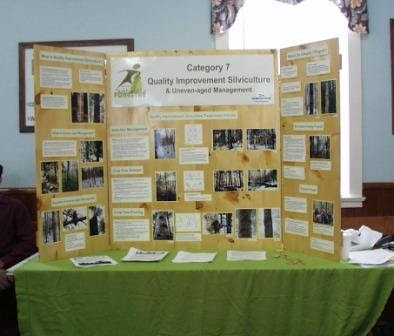
Above, Registered Professional Forester Patricia Amero of Picea Forestry Consulting reports to the group on the success of the Outreach Project that the NSWOOA is conducting under a contract with the Association for Sustainable Forestry. Funding for this project is provided by the Nova Scotia Department of Natural Resource. Below, the Outreach Project has taken this display, hand-made by newly elected NSWOOA board member Sandy Hyde, to Woodlot Owner Conferences and other woodlot-owner meetings all over the province.


Patricia Amero of Picea Forestry Consulting presented a report on the Uneven-Aged Management Outreach Project that Picea is doing together with the NSWOOA. She summarized the features of the program, and outlined accomplishments to date. The project seems to be going very well and is on schedule. There are already about 250 woodlot owners in the database and more taking the survey every day. Read about the educational sessions below. Space is limited and pre-registration is required, so get in touch with the Outreach Project soon if you want to attend.


Above, NSWOOA Director Austin Parsons takes notes during his presentation on the Board's proposed submission to Voluntary Planning.

Director Austin Parsons presented the Board's proposed Voluntary Planning submission. It was in four parts. The first discussed forest diversity and healthy ecosystems as the basis of a diversified forest product industry. Diversity means sustainability and flexibility, whereas one product means rigidity and lack of sustainability. The second part dealt with the need for simplification and standardization in the industry. It would be much easier if all mills described their specifications in the same terms, and used the same criteria and paperwork for their Registered Buyer funds. The third section dealt with viewing woodlot owners as entrepreneurs who manage legitimate businesses. How can the business owners gain control of the resource? The final section was the recommendations and actions needed to bring about desired change.
Comments were vigorous and extremely helpful to the Board for their final revision. The presentation drew many compliments from those attending.

Lunch was followed by a lively panel discussion of "Hot Topics" such as Acadian Forest Restoration, biomass production, and global climate change. Below, NSWOOA President Lorne Burrows and Past President Tom Miller were among those who spoke during this discussion.


Lorne Burrows

Tom Miller


Cause to Celebrate

Three new directors were chosen for the NSWOOA board at the AGM: Tony Phillips, Sandy Hyde, and Kermit DeGooyer. Congratulations and welcome aboard.

Category 7 Outreach Project

Our Uneven-Aged Management Outreach Project will be conducting workshops and field trips throughout the province in May and June.

Focused on selection management, crop tree release, and crop tree pruning (silviculture methods that help woodlot owners to grow high-value trees), these free workshops are scheduled as follows:
• May 3, Digby County, Richfield area
• May 10, Colchester County, Earltown area
• May 24, Queens County, North Brookfield area
• June 7, Victoria County, Middle River area
• June 14, Antigonish County, St. Joseph area

Space for the Uneven-Aged Management Project workshops is limited, and pre-registration is required. To register, please call 902-673-2278 or email outreach@asforestry.com

Old Fields

An excerpt from Jamie Simpson's new book Restoring the Acadian Forest, p. 93. Used with permission.
Years of agricultural use typically have changed the soil composition and structure of [old fields]…. Some sites have a soil condition known as hardpan, caused by decades of ploughing to the same depth and which limits proper drainage and rooting. Course woody debris and, in some cases, nutrients and organic soil matter are even lower than in recent clearcuts. Plants common in abandoned fields—known as pioneer species—are able to withstand poor conditions, so they play an important role in rejuvenating such sites. With time, fields that are not mowed will eventually fill with pioneer species. The early successional plants protect the soil from erosion, add nutrients, and build organic matter. They also add shade and increase moisture levels, creating suitable microclimates for later-successional species and providing food and nesting sites for wildlife. Many of the pioneer trees grow fast and haverelatively short lives, so they provide a relatively quick source of standing and fallen deadwood. White spruce is a common component in this succession, along with species such as tamarack, white birch, poplar, cherry, alder and willow.
Lines of Communication

Members are encouraged to contact the Board of Directors, the Executive and other members through our email address (nswooa@gmail.com) or by phone (902-633-2108 or, for member services, 902-673-3009). Please feel free to use these methods to keep us informed of what is going on in your woodlot or in your community or area. We try to keep you informed through these updates, newsletters and mail outs, our column in Atlantic Forestry Review, the Annual General Meeting, and this website.

NSWOOA Update 11: February 2008

Hello Woodlot Owners!

There's No End to It! Responsibility , that is. There is no end to responsibility for woodlot owners. There you have it; it's been said, straight out. Besides all our usual responsibilities, woodlot owners now have an additional one.

The new responsibility is to voice our vision of what forest policy and practices should be in Nova Scotia in the future to the review of natural resources policy being conducted by Voluntary Planning. Previously reviews were conducted by DNR itself, and while there were opportunities for woodlot owners and citizens at large to make presentations and submissions, the knock is that these inputs were then almost completely ignored when DNR consulted industry and made its final policies and regulations.

Under pressure from the NSWOOA and many other groups and individuals, the Government of Nova Scotia has opened up its review by asking a third party, the Voluntary Planning organization, to conduct the review and to be involved in distilling the input from the public, woodlot owners and industry into recommendations for the government to consider.

This is where our responsibility as woodlot owners comes in. Individually and through our organizations, we have the responsibility to make presentations and submissions to this Voluntary Planning panel.

Hearing a vision or recommendation once is not enough for such a panel to think it important, no matter how valid, utile or insightful it is. Hearing a chorus of similar views and concerns does influence the end results. A veritable groundswell of voices repeating and stressing these views and recommendations will demand inclusion in the final product.

The NSWOOA is preparing its vision of the new forestry with the values, policies and regulations that we feel should be in the final recommendations. As individual woodlot owners you have not only the opportunity but—some would say—the duty to make your individual ideas known. They reinforce each other. Hopefully every woodlot owner can have an impact by making a presentation directly or having input to a woodlot owners' group that is making a presentation.

Here is a partial list of topics on which woodlot owners might give advice for policy development:
  • Property rights
  • The need for contractors who will harvest wood by methods other than clearcutting·
  • Herbicide spraying
  • Using wood to generate electricity or bio fuels
  • Hardwood management
  • Whole-tree harvesting
  • The need for value-added industries
  • Niche markets
  • Biodiversity
  • Wildlife protection
  • Changing the structure of the forest industry
  • Riparian zones
  • Rural development
  • Marketing systems
  • Silviculture assistance
  • Availability of seedlings
  • Acadian Forest restoration
  • Management plans
  • Technical standards for silviculture
  • Subsidies to large corporations
  • Clearcutting restrictions
  • Enforcement of environmental protection regulations
  • Carbon credits
  • Dedicating more funds for Category 7 Uneven Age Management
  • Species utilization
  • Exporting raw material

You are encouraged to make every effort to put forward your ideas to the review process.

Annual General Meeting News: Some Changes

The NSWOOA's Annual General Meeting, to be held on April 12 in Great Village, will have the title "Hot Topics of 2008-2009." Among topics to be addressed is the presentation the NSWOOA will be making to Voluntary Plannin, as described above. We are now preparing recommendations that will be presented to our Annual General Meeting for discussion and possible adoption.

In addition, we expect to have presentations and discussion on issues such as biomass and the recent FSC certification of the former StoraEnso mill in Port Hawkesbury, which now belongs to NewPage Corporation. Members will also hear an update on the Uneven-Aged Management Outreach Project, which is described below.

This is an important meeting, and we hope all members will want to attend in order to learn about these topics, join the discussion, and participate in the business meeting as well.

Registration will begin at 8:30 am with the business meeting to start at 9 am. The program will last until 2:30 pm with breaks for coffee and lunch. Registration is $20 per person, which includes lunch. The program will be held in the Masonic Hall, 30 Station Road, Great Village.

Take our survey and have a chance to win a prize

The NSWOOA has begun work on an exciting new campaign to promote uneven-aged management techniques among woodlot owners and contractors. The Uneven-Aged Management Outreach Project now has a telephone number (902-673-2278) and email address (outreach@asforestry.com). We hope all woodlot owners and contractors who are interested in uneven-aged management or the Category 7 Quality Improvement Silviculture Program, which provides funding for treatments associated with uneven-aged management, will call or email us so that you can receive our packet of information materials and be notified of upcoming educational sessions.I

f you call the outreach number, you'll be asked if you want to take a survey. Please help us make sure we collect information from as many woodlot owners and contractors as possible, particularly ones with an interest in uneven-aged management. Everyone who takes the survey will be entered in a prize drawing to be held in September, and we have some great prizes lined up.

Also in the planning stages are workshops and field days to be held all over the province. Be sure to get on our mailing list in order to get an invitation to one of these meetings.

The Uneven-Aged Management Outreach Project is being conducted by NSWOOA under a contract with the Association for Sustainable Forestry and is funded by the Nova Scotia Department of Natural Resources. Our partner in delivering services under the contract is Picea Forestry Consulting and Woodlot Management of Bridgewater, NS. Information about the project will be posted both at the NSWOOA website and at the ASF website, http://www.asforestry.com/Category7program.htm

A Membership Benefit

Any NSWOOA member attending the April 12 meeting is encouraged to set up a display booth for any timber or nontimber product or service provided. Of course you can provide business cards and fliers for those in attendance, whether you have a display or not.

Some Thoughts on Forest Biodiversity

The following is an excerpt from Jamie Simpson's new Restoring the Acadian Forest: A Guide for Woodlot Owners in the Maritimes (p.55). Keep your eyes open for this excellent book when it comes out for sale.

Genetic diversity is not a common topic of discussion of woodlot
management. Nonetheless, its importance to forest health is immense. Sufficient
genetic diversity means there are enough individual differences within a species
that it has a chance to adapt to a constantly changing world, where failure to
adapt means failure to survive. … In making decisions about tree cutting and
planting, woodlot owners collectively help to shape the genetic diversity of the
Acadian Forest system. …

These little differences within each individual are important. Combined
they are a storehouse of 'possibilities' that can allow a population to respond
over many generations, to changes in the environment. So long as there is
sufficient genetic diversity, some individuals will have the traits necessary to
survive environmental changes and will pass these traits onto the next
generation. (Used with permission).

So, what provisions have you made for genetic diversity on your woodlot? Let us know if you have had any interesting and successful projects to encourage genetic diversity.

Changes in Forestry Ownership and Their Possible Impact on Forestry and the Environment

By Director Gerald Romsa

There are some data appearing in the literature that ownership of large blocks of Forest Land (five thousand acres plus) in the NE United States (Northern New York, Vermont, New Hampshire and Maine) has shifted from forestry oriented owners to non forestry owners. In Maine by 2005 around 40 % of the forest land was owned by enterprises which have short term (10 year) business horizons. Land is treated by a new breed of landowners as a commodity to be sold for the highest price in the real estate or other markets. Forestry and environment groups are becoming quite concerned. Such changes are leading to less predictability in the future of the forest and in biodiversity practices. Many present forestry and related conservation practices are not fully applicable to this shift in ownership patterns. The new owners can argue they are not involved in the forestry sector. The question is, how does one mitigate potential downsides and maintain the forestry and environmental sectors in the face of changing interests of new forestry owners. In the North Eastern forests mentioned above some approaches have been to purchase large tracts of environmentally sensitive and genetically desirable tracts by having the new owners sell the desired parcels at the average selling price to conservation groups.

We need to examine the question of form of land ownership and its impact on Forest Policy.

Is there a pattern of forestry areas being bought up (1000 acres or larger) by owners whose interests are not primarily forestry related? If so are these owners from the Maritimes or elsewhere?
  1. What is their commitment to an environmentally sustainable forestry?
  2. Will present or proposed forestry policies work if forest areas are owned by non forestry interested owners whose desire for income arises from non forestry practices?
  3. What could such changing land ownership practices do to an environmentally sustainable forestry and to environmentally and biologically sensitive, threatened and unique areas?
  4. What could such changes in forest ownership do to the evolution of a carbon neutral society?
  5. How does Nova Scotia protect the Forest, the environment and threatened and unique habitats from changes in forest ownership or land owners philosophy?
Are the following feasible?
  1. Require new owners of larger blocks of forest land to sell to the Province or Conservation groups a portion of the land for the average price they paid?
  2. Is it feasible to use an urban planning approach that requires owners proposing a new land use/management policy to donate a portion of their land to the public (Province/County/Municipality/Conservation-Environment Group)?
Your input and reaction is invited to the email address below.

Invitation to a CAPE Meeting

CAPE (Citizen Action to Protect the Environment) invites the public to a presentation, "Forests for Life", on Thursday, February 28, 7:00 pm, at the Dr. Arthur Hines School in Summerville, Hants County. Concerned about clear-cuts? Worried about more herbicide spraying near your land? Wondering what forest management has to do with climate change and what you can do to help? Come and hear from the Ecology Action Centre's Standing Tall: Forests for Life Campaign. This hardhitting presentation gives you the facts about forestry in Nova Scotia --and suggests how we can achieve real changes that will preserve and protect our woodlands, water, and wildlife. Between April and June of this year, consultations will be held around Nova Scotia through a process called Voluntary Planning to find out what we think should be part of a new 10-year Natural Resources Strategy. Come and learn the different ways that you can have your say at these consultations and help determine what is done about forestry, mining, parks, and biodiversity in N.S. You can have your say about what happens in our forests, and help address the issue of climate change. Refreshments. Storm date is Tues., March 4. For more info, call Barbara at 633-2513, Merton at 633-2086, or Marilyn at 633-2051.

Lines of Communication

Members are encouraged to contact the Board of Directors, the Executive and other members through our email address or by phone (902-633-2108 or, for member services, 902-673-2278). Please feel free to use these methods to keep us informed of what is going on in your woodlot, in your community or area. We try to keep you informed through these updates, newsletters and mail outs, our column in Atlantic Forestry Review, the Annual General Meeting and this website.

NSWOOA Update 10: January 2008

Hello Woodlot Owners!

Picture this: It was a warm sunny day in early hunting season in, probably, the mid eighties. Twenty-eight "townie" teenagers were following Maurice Bruhm and their grade 11 Economics teacher around Maurice's sawmill in Cornwall, Lunenburg County, and then on a tour of his woodlot. In their hands, the kids carried a sheet of questions which would elicit information from their guide and provide the substance of their field trip report.

For those of you who knew Maurice Bruhm, it will not be hard to conjure up his thick Lunenburg County "Dutch" accent, or his quiet, thoughtful way of speaking. In fact, Maurice spoke so quietly and unassumingly that the visitors had to be very still and to listen intently to catch his words.

At one spot, Maurice stopped by some flagging tape tied to some shrubs. No one knew what the plant was. "Labrador Tea," said Maurice. "I don't know what to do about it. It was pointed out to me that it was there, so I marked it to keep it from being destroyed. We tend to destroy things if we don't know they are there. So I marked them." Such were his lessons.

At the next stop, Maurice showed the students a particularly fertile area, a ridge of good soil that grew trees very well. He explained that he had harvested trees there a number of times in his life time, and his father had before him, and that there was as much wood on this land now as there had ever been. This was his lesson in selective harvesting.

The third stop was another stand of mostly conifers, about six to seven inches in diameter. Without even the hint of a smile he quietly stated that he was going to wait until there was 100 board feet of lumber in each tree before he cut them and milled them. There were no comments from the students, as they jotted this information on their fact sheets.

Later, when questioned alone about his bold statement, Maurice claimed that he couldn't resist testing to see if the youngsters understood the concepts he was getting at. And, it seems, he was enjoying his joke on them. Youth seldom has a sense of the passage of time that comes with working with the forest. He smiled at it all.

Sadly, Maurice passed away a few years later, a great loss to his family and the community. As for his visitors, doubtless their lessons that day have informed them of forest management issues thereafter. More of our youth should have the opportunity to be guided by the Maurice Bruhms of this province.

You Are Invited…

On Tuesday January 22 at 7:00 pm there will be a meeting of interested directors and NSWOOA members at the Community Room in Elmsdale Superstore.

The purpose of this meeting is to decide upon the content, form and vision of the NSWOOA's presentation to Voluntary Planning's Natural Resources Strategy Project Committee, which is going to make recommendations for a long-term strategy for provincial forests, biodiversity, and other natural resources. (For more information about this process see the Voluntary Planning website .) The NSWOOA was one of several organizations that called on the provincial government to put Voluntary Planning in charge of developing a new natural resources strategy. It is expected that the session on January 22 will produce a document that will be presented to our Annual General Meeting for discussion and possible adoption.

This is a very important issue and opportunity. Please make an effort to attend.

Uneven-Aged Management Outreach Project
By Flora Johnson, NSWOOA Member Services Coordinator

As many of you already know, we have begun work on an exciting new campaign to promote uneven-aged management techniques among woodlot owners and contractors. The Uneven-Aged Management Outreach Project now has a telephone number (902-673-2278) and email address (outreach@asforestry.com) . We hope all NSWOOA members will call or email us so that you can receive our packet of information materials and be notified of upcoming educational sessions.

Please note that the Outreach Project telephone number given in the last update unfortunately had to be changed after the update was sent. If you called that number and did not receive an answer, please try us again at 673-2278. We apologize for the inconvenience.

Outreach Project staff are putting the finishing touches on a survey that we hope to administer to woodlot owners and contractors who contact us. Please help us make sure we collect information from as many woodlot owners and contractors as possible, particularly ones with an interest in uneven-aged management. Just email me at the outreach@asforestry.com, and I'll be happy to either send you a copy of the survey via email or call you and ask you the questions in person.

Also in the planning stages are workshops and field days to be held all over the province. Stay tuned for updates about these as they are planned.

The Uneven-Aged Management Outreach Project is being conducted by NSWOOA under a contract with the Association for Sustainable Forestry with funding from the Nova Scotia Department of Natural Resources. Our partner in delivering services under the contract is Picea Forestry Consulting and Woodlot Management of Bridgewater, NS. I would like to express my personal thanks to Patricia Amero, Registered Professional Forester and one of the owners of Picea, for her hard work and dedication to this project.

AGM Planning Has Begun

At the January 10 Directors meeting, the initial planning for this year's AGM began with the decision to hold the meeting in the Elmsdale area on Saturday, April 12. Decisions are tentative at this stage, but the character of the event is taking shape.

The overall theme is value woodlot products and value added wood products (as opposed to large quantities of low valued products). Of course there will also be the business meeting and such to be done.

Morning events will probably include a presentation on the Category 7 Outreach Project and a presentation/discussion of our forestry practice submission to the Voluntary Planning review of provincial natural resources policy. Be sure to be there to have your input heard.

The afternoon will probably see a tour of a sawmill, with the opportunity to ask questions of the mill managers, wood buyers and so on.

Depending on the size of the facility chosen for the meeting, booths may be available for members and others to display their products and advertise services. If you are interested please contact us at nswooa@gmail.com so that we may gauge interest. As well, we invite members to supply business cards and pamphlets for those attending to pick up at the registration desk.

As mentioned, plans are only tentative at this point, but the meeting seems to be shaping up to be a really valuable event to attend. Stay tuned for additional information—times, locations, etc. Information will be posted on this website, and you will receive a notice about the meeting along with a request to renew your membership if you haven't already.

Membership Renewals

Please remember that membership fees are our main source of income, and this is renewal season. Memberships go with the calendar year, and almost every one of us has to renew for 2008. If you have friends or neighbors who are interested in the issues and concerns that we deal with please invite them to join our ranks. You should soon receive a renewal notice from Flora, our membership coordinator, by email or by regular mail. Flora will also be sending a renewal form with the newsletter/notice of meeting for the AGM, for those who have not yet paid.

Membership renewal forms can be mailed in directly. We will also accept memberships at the Annual General Meeting on April 12.

An Interesting Request

Director Austin Parsons, who teaches architecture, has received the following request from a student, and passes it along to us: "I was wondering if you could direct me to a directory of sustainable woodlots in the province--specifically in Colchester County. I've been hunting around on the internet but am not coming up with much."

Austin explains that he does not know of any directory, or for that matter, if anyone has an agreed upon definition of a sustainable woodlot. He remembered that Kim Thompson had compiled the Eastern Shore Wood Directory, but not much more came to mind.

It seems that there is a need for various directories around the province, as we often get queries from woodlot owners and others for a directory of FSC products, of portable sawmills, of particular products, of horse loggers, of silviculture contractors, and, of course, contractors who will do multi-age multi-species harvesting.

The Standing Tall Campaign for Environmentally Responsible Forestry has compiled a list of woodlot owners supplying FSC-certified wood. If any members out there have knowledge of a directory that would be of use to Austin's student, or other directories that cover any of the other categories, please advise us by email. We will pass the information along. Perhaps we could compile a directory of directories.

Conservation of Working Land

Note: There has been interest lately in conservation easements attached to lands, or other methods by which owners can protect their forest land from practices they deem unfit, after they are deceased. There are a variety of methods and institutions available, and some are more suitable in some instances than others. Jennifer Scott's article below details one method. Hopefully we will receive details on other methods and pass them along as well. Incidentally, Rupert Jannasch, cited below, is a NSWOOA member.

Two Nova Scotia farms protected by conservation easements
By Jen Scott

Working land is land that is worked to produce food or forest products. This kind of land might be worth protecting because it is important for food production, it contributes to biodiversity, it has been well taken care of for generations, or it has valuable woodland that should not be clearcut. The land might be threatened by urban sprawl, or by economic conditions that would make it tempting for the landowner to sell off parcels, or clearcut the woodlot.

How can we protect important working land? One way is to use a conservation easement--a legal document that is attached to the deed, placing restrictions on the use of the land even if the property is sold. The easement is negotiated with the landowner, then registered with the province. A designated "eligible body" takes on the responsibility of ensuring the landowner adheres to the terms.

The Ecology Action Centre (EAC), based in Halifax, has been added to the Eligible Body list under Nova Scotia's Conservation Easement Act. Through its agriculture-oriented sub-group called Heliotrust, the EAC now holds easements with two farms in Hants County: Avonmouth Farm and Red Fox Co-op. EAC does not own the farms, but as the easement holder, it has an interest in ensuring the 300 acres are managed in an ecological manner, according to the terms of the agreements. To that end, a community-based monitoring system will be developed.

These two conservation easements are structured to protect the farm and woodland from subdivision and development, but they are for "working" land, as opposed to "wild" land. This is an important distinction, as it recognizes the stewardship responsibility of the farmer. The land must be managed in an ecological manner, no matter who owns it.

In signing the conservation easement, the farmer gives up some of the real estate value of the farmland, because it cannot be sold for non-farm purposes. This makes the land more affordable for the next person who wants to purchase it for farming.

The real estate value of a farm is a function of what people would be willing to pay for it. This makes farms closest to urban centers, and those with particularly beautiful attributes, the most vulnerable to speculative hikes in value. Theoretically, the value of the conservation easement is roughly equivalent to the difference between the market value of the land and its productive value as a working farm. In negotiating what it would pay the owners of Avonmouth Farm and Red Fox Co-op, the EAC obtained independent appraisals from a farm economist and a real estate professional.

Both farms have woodlots, but woodlands on Avonmouth Farm are a significant part of the farm operation. Rupert Jannasch took over Avonmouth in 2003, and has been developing various horticultural and forestry enterprises. He says he is pleased with the easement agreement, but he points out that an agricultural landowner who trades away development rights is assuming a degree of risk. "Consider a scenario in the future when a landowner, a farmer, no longer wishes to or is unable to farm," says Jannasch. "He still owns the land, but sold a conservation easement 20 years earlier prohibiting other uses. No young farmers are waiting to fill his shoes. Perhaps new food safety regulations make it impossible to produce food, or there is no longer a willing labor force. . . . What does the landowner do?" Such uncertainties must be weighed against the benefits of protecting the land.

A government program or a larger charitable organization with significant financial resources would be able to achieve the same objective by purchasing agricultural acreage and leasing it to farmers, but in the near future there are no prospects for this in Nova Scotia. For now, the protection of farmland depends to a large extent on landowners' commitment to the principle.

Heliotrust has set up a special conservation fund, with the interest to be used for monitoring conserved land and covering any legal fees that may be necessary to ensure compliance with the terms of easements in the future. The EAC hopes to increase the fund in order to protect more working land. Charitable receipts are issued by EAC for donations. To contribute to the working land conservation effort, specify that the donation is for Heliotrust's farmland conservation fund.

News and updates from Heliotrust may be found at The Heliotrust Journal.

Lines of Communication

Members are encouraged to contact the Board of Directors, the Executive and other members through our email address or by phone (902-633-2108). Please feel free to use these methods to keep us informed of what is going on in your woodlot, in your community or area. We try to keep you informed through these updates, through newsletters and mail outs, our column in Atlantic Forestry Review, the Annual General Meeting and this website.