Showing posts with label biomass harvesting. Show all posts

NSWOOA Update 24: May 2009

In this issue
Voluntary Planning
The NSWOOA seeks your opinion
Fall Field Day
Biomass harvesting
Using silviculture funding to help pay for restoration
The new executive
Update on Irving land sale
How to contact us

Hello Woodlot Owners!

Public Opinion

At the recent Annual General Meeting (AGM) Robin Barrett made a short presentation on the work of Voluntary Planning. It was their job to gather public opinion on the policies and practices in forestry, on parks and recreation, on biodiversity and on minerals.* They gathered these opinions, distilled them into themes and workshopped the results. Now they are prepared to pass the material over to four “panels of experts” who will make specific recommendations to a third and higher level panel whose job is to recommend policy to government. The panels of experts are yet to be named from the list of nominees, pending formulation of the final panel, indicated Robin.

So what are the main findings of the process so far? According to Robin, that theme is public participation. Over and over again presenters indicated that they wanted the public—ordinary concerned citizens like themselves—to have a mechanism through which they can have a meaningful role in determining public policy and practices. The quality of presentations from woodlot owners and members of the public at the VP hearings certainly indicates that there is a large body of people out there who have educated themselves on all aspects of forestry. There certainly is enough expertise among the general population to successfully argue that the public does really understand the forest, and thus their views should not be discounted when it comes to formulating forest policy. Recent shifts in programs, such as the Category 7 Quality Improvement Silviculture program and the newer woodlot certification program, seem to indicate that in the present day DNR attitude is more consultative. Things are looking up.

One can hope that the great demand for ongoing public input into forestry policy and practices will be satisfied. What the mechanism could and should be is difficult to imagine. There is certainly a range of opportunities, from boards and committees to discuss particular problems to the establishment of community-managed forest blocks.

What are community forests? Basically a community forest is a block of forest land that is managed according to the principles, practices and objectives of a group or “community” of citizens. A quick survey reveals that some community forests are public land only, set aside for an interest group to manage. Other forests are composed of both public and private lands. Aboriginal community forests are becoming more common. The question is this: Is it time for various groups in the Province to look into the community forest concept as a means of influencing forest policy and practice?

Where do you stand? How much are you willing to contribute? What structures would allow you the input and influence you would like to contribute?

*The NSWOOA is interested in all these topics, but especially forestry. The Board made a strong presentation to the VP process, backed up by the fact that members attending the 2008 AGM formally approved the presentation.

Something to Keep You Busy

Speaking of public input, members of the NSWOOA are being asked for their responses to a number of issues and proposals. Here is a list of the topics that you are asked to phone or email your thoughts on. Here’s your homework. It should fill in a half hour or more for you.
  • What should the NSWOOA adopt as a policy on forestry? Do we have a common stand, and if so, what should it be?
  • What membership services should we be providing? What do we do well, and what have we been neglecting?
  • Is this website giving you what you need? Is there something more that we have missed?
  • What role should we take in the Bancroft/Reed lawsuit against a federal and two provincial ministries for failing to protect the environment?
  • Should we be involved in the Friends of the Redtail Society’s efforts to buy some Wagner land to use as a community resource?
  • What is our position on biomass harvest? On building biomass-fired electrical or oil-producing plants?
  • If you have been the victim of timber trespass, or have experiences on the topic to share, Tom Miller wants to hear from you. Please take the time to call us (633 2108) or email us .

Sept. 19 NSWOOA Field Day
By Steve Harder

This year’s field day in Pictou County will showcase the diversity of a working woodlot and a naturally regenerating forest.

Lloyd and Marlene Langille of the Hopewell area, near New Glasgow, will host the event on Saturday, Sept. 19.

The Langilles have been harvesting wood from a 130-acre mixed woodlot annually for more than 40 years. But they’ve done so mainly through selection harvesting—cutting trees singly or in small groups—so wood volume has been retained and cut areas are vigorous and healthy with natural regeneration. They try to avoid clearcutting.

“If you take it all in one shot, you can’t go back, at least in your lifetime,” says Marlene.

Lloyd keeps going back, removing logs using a tractor and winch. Up until about 10 years ago, he and Marlene used horses to take out the logs. Lloyd still sometimes brings in a horse in special spots where he doesn't want to cut a road for the tractor.

The field day will feature local food for lunch and horse and wagon rides to different parts of the woodlot.

Activities planned for this year’s NSWOOA field day include practical examples of woodland stewardship and discussion of broader issues of conservation and biodiversity.

Guest presenters will include Bob Bancroft, a well-known wildlife biologist who, along with his artist wife Alice Reed, is preparing to legally challenge provincial government officials over their failure to enforce existing land and water regulations that could have protected their 32 years of environmental stewardship.

A spokesperson for the Friends of the Redtail Society will speak about the nonprofit group’s efforts to raise funds to prevent a large parcel of land, some of which is old forest, from being clearcut.

Though the final agenda hasn’t been set, ideas being considered are:
    1. Use an old field White spruce site, which is very common stand type on Nova Scotia woodlots, to show how these sites revert back to a natural forest.
    2. Discuss topics such as old growth, habitat, and tree silvics along a trail network using examples of mature mixedwood stands (Eastern hemlock, Red spruce, Yellow birch, Red maple and Sugar maple).
    3. Show the importance of riparian areas using small brooks as examples.
    4. Demonstrate how silviculture, particularly selection harvesting, can be used to mimic natural processes of the forest through the implementation of various-sized patch cuts to encourage various ages of multi-species regeneration and thinning activities to promote growth of existing good-quality trees.
    5. Mark an area of trees to help illustrate to landowners which tree should be cut and which tree should be left to grow and how this can vary depending on the landowner’s values and objectives.
    6. Describe the province’s forest ecosystem classification system by showing soil and vegetation types and explain some hazards and advantages of different types.
    7. Show the importance of soil biology, particularly in terms of long-term site productivity and ecosystem health.
    8. Describe the role of wetlands in a healthy forest and their value in providing ecosystem services in filtering water and maintaining biodiversity and wildlife habitat.Display and operate a portable sawmill and explain how scaling and grading work.
    9. Demonstrate how woodland owners can get value from non-timber forest products.
    10. Provide information on outreach and silviculture funding programs offered by the Association for Sustainable Forestry.
    11. Demonstrate raptor habitat with some examples of potential nest sites to show how to identify such habitat and potential habitat.


    From this broad list of topics, a number will be selected for the Sept. 19 field day. If you have any suggestions or comments about the proposed demonstrations or events, please contact NSWOOA board members or send an email to nswooa@gmail.com. Stay tuned for more details on the final agenda and the format for the day’s activities.

    The board of the NSWOOA invites members and anyone interested in woodland stewardship to attend the field day. To learn, share ideas with like-minded people and have fun.

    Biomass Harvesting Guidelines
    By Wade Prest

    As reported at our AGM in April, the NSWOOA resigned from the NS Biomass Working Group, which has been given the task by DNR of developing guidelines for the harvest and retention of forest biomass in Nova Scotia. Recently, the latest draft was released for comment by interested stakeholders, including the NSWOOA. Interested members may contact the Board or Wade Prest to get more detail of the current version. Any members who would like to comment on the guidelines should contact Wade at 902-772-2211 before June 5, so that your concerns can be taken into consideration as the Association’s comments are prepared.

    The guidelines will be mandatory on Crown Lands, and private landowners will be encouraged to follow the guidelines on their own properties. There are two main classes of biomass identified as important to the maintenance of site productivity. One of those is coarse woody debris (CWD), which is standing and fallen trees (or pieces thereof) over 10 cm in diameter. For some years now, guidelines for the retention of CWD have been in place in Nova Scotia, as part of the Wildlife Habitat and Watercourse Protection regulations. The recommended volumes of CWD to be left on harvested sites are based on observed CWD volumes in mature natural unmanaged stands. This will more or less be unchanged. The second category is the fine woody debris (FWD or “fines”), which is defined as tree components less than 10 cm in diameter, typically tops, limbs, twigs, and foliage. Recommendations are made for the amounts of this material which should remain well distributed on the site following harvest. The amounts vary with the site quality (from no removal on poor sites to 75% removal on better sites) and with silvicultural system (even-aged vs.uneven-aged management).

    At this point, the NSWOOA still has grave concerns that harvesting more material (over and above stemwood) is an unsustainable practice. There is ample evidence in the woods that our forests are stressed, unhealthy, and often growing at a rate less than it should be. That should not be surprising, given the treatment many woodlots have experienced in the past. Unfortunately, the Biomass Working Group has offered no basis for its recommendations, and we will be expressing these reservations in our comments. Although these are only guidelines and woodlot owners are not obliged to follow them, your Association would prefer to see the Province issue guidelines which we can recommend to our members. As it stands, the NSWOOA will continue to urge its members to think of the long-term health and productivity of their woodlots, and consider a reduction in the level of biomass utilization, rather than stripping the land of its lifeblood for minimal short term financial gain.

    UAM Notes: Using silviculture funding to help pay restoration costs, part one
    By Patricia Amero, RPF

    If you are trying to restore Acadian Forest species and structure on your woodlot, you may be able to use silviculture funding programs to help offset the cost of these efforts. These programs are available throughout Nova Scotia.

    For example, a common occurrence in Nova Scotia is a stand dominated by mature pioneer species such as White spruce and/or Balsam fir, where the regeneration consists primarily of fir. In more cases than not, species such as Red spruce, Red maple, White ash, and Yellow birch can be found scattered among the regenerating fir, particularly where there are partial openings in the upper canopy. (Partially shaded conditions are most favorable for these shade-tolerant species.) When desired species are not regenerating naturally, you can plant to boost the proportion of desired species. This will move succession along and establish seed sources of shade-tolerant species for the next generation forest.

    Which species to plant depends on your management objectives and the soil and vegetation types that naturally characterize your forest. If you want to qualify for funding, you must plant tree species with commercial value, which are referred to as crop trees. At this time, species that would be funded include Red spruce, White pine, Red pine, Eastern hemlock, Yellow birch, Sugar maple, White ash, and Red oak.

    When an area does not have enough desired species in the desired locations, you can remedy this by planting the desired trees. In forestry terms, this type of planting is referred to as fill planting. Underplanting is a type of fill planting in which trees are planted under partial canopy. In restoration efforts, fill planting is especially useful in situations where there is a shortage of seed sources for desired species.

    Money is available to help pay for fill planting under Silviculture Category 1 (“Natural Regeneration Establishment”) of the province’s Forest Sustainability Regulations. Although the reimbursement varies, typically it is $300 per hectare.

    In order to qualify for funding under Category 1, you must meet certain criteria:

    • You must plant acceptable species, as described earlier.
    • You must plant at least 300 trees per hectare. (This is not very much.)
    • After planting, at least 17% of the area must be stocked with planted trees.
    • After planting, 80% of the area must be covered by trees of acceptable species. These trees may be either naturally regenerated or planted.
    • Any planted hardwood species must be protected from browse, and no funding is available to help offset the cost of protecting these seedlings.


    If you are fill planting 300-500 trees per hectare and if certain other conditions are met, a site such as this one might be eligible for additional silviculture funding under Silviculture Category 7 (“Quality Improvement”) of the Forest Sustainability Regulations. I’ll talk more about using fill planting together with selection management in the next edition of the NSWOOA Update. Following that, I’ll talk about how to use fill planting along with manual weeding in cut-over areas where most of the regeneration consists of pioneer species. Finally, I’ll explain how the funding process works and talk about what to do if you are interested in applying.

    For more information on uneven-aged management, please check my blog.

    The New Executive
    In accordance with the By-Laws of the NSWOOA the Board of Directors at its first meeting following the AGM elected a new slate of officers.

    President: Austin Parsons

    Vice President (open temporarily)

    Treasurer: Tony Phillips

    Recording Secretary: Paul Brison

    Corresponding Secretary: Ken MacRury

    Central Wood Supply Division:
    President: Lorne Burrows
    Secretary: Paul Brison

    The new executive thanks members for their support and asks that you make the extra effort to keep in contact, so that we may be better able to serve your needs.

    Update on Irving Land Sale
    By Kermit DeGooyer

    The provincial government has taken a small step to secure some of the 214,000 acres of land that JD Irving Ltd. is selling in southwestern Nova Scotia. During a rally organized by Buy Back Nova Scotia at Province House on April 30, Natural Resources Minister Carolyn Bolivar-Getson announced that the government was bidding on 21,000 acres. This amounts to 10% of Irving’s holdings currently for sale, and if acquired, would be added to the Crown Land base. Most of the land is in the Silver and Caribou River watersheds in Digby Co. The Province is also putting in offers on a few small scattered parcels that contain old or uncommon forests, like the cedar swamp at Hectanooga. The Buy Back Nova Scotia coalition had hoped for more, and have pledged to continue pressing government (of whatever stripe we end up with) to acquire Irving’s lands. The coalition ranges from environmental groups and trail clubs to trappers and local businesses. They hope to prevent such a large area falling into the hands of real estate speculators, who tend to liquidate the forest, ring backcountry lakes with exclusive housing lots, and kick everyone out. Every municipality in the region has endorsed the Buy Back effort. For more, check out http://www.buybacknovascotia.ca/

    Lines of Communication

    Members are encouraged to contact the Board of Directors, the Executive and other members through our email address (nswooa@gmail.com) or by phone (902-633-2108 or, for member services, 902-673-2278). Please feel free to use these methods to keep us informed of what is going on in your woodlot or in your community or area. We try to keep you informed through these updates, newsletters and mail outs, our column in Atlantic Forestry Review, the Annual General Meeting, and this website.

    NSWOOA Update 17: October/November 2008

    Hello Woodlot Owners!

    Kudos

    Demo 2008 afforded the chance to pick up DNR's Module 13 in the home study series: Non Timber Forest Products: Growing Opportunities. The whole series is worth reading, and for anyone new to forest management the modules can be a great assistance in getting up to speed in preparation to make decisions on your own woodlot.

    The new module, by David Sutherland, takes a look at both consumptive and nonconsumptive NTFPs, as they are called. The module is straightforward, and covers a wide variety of products and opportunities. It is, of course, a well-illustrated survey of what is being done by some woodlot owners now and what might be done in the future to enhance the financial return from your woodlots. Thus, it does not get into some of the nitty-gritty of setting up businesses based on these products, but it does approach the issues with optimism and clarity.

    Perhaps the best advice in the whole module comes in the early part of the book, page 7: "Now perhaps more than ever, natural products have an appeal to most people as they pursue healthier lifestyles. An endless array of products claiming to be 'all natural' are common on store shelves. Often the manufacturer's name implies a bond with the wild untamed world: 'frontier', 'Backwoods', 'wilderness', and 'Forest health' all appeal to the consumer. The seller of non timber forest products can add market value by using the right words."

    He's right. A good many times it is not what you have to sell, it's what you call it that makes people want it. The lesson can be extended to even the name of your NTFP business.

    It is also worthy of note that carbon sequestration is identified as a possible NTFP from private woodlots. That concept is certainly progressive. Hopefully DNR is now working on that issue!

    Good job, Mr. Sutherland.

    New Executive

    The NSWOOA works for you because of volunteer efforts of woodlot owners like yourselves, that dedicate time and effort to the cause. The current executive consists of:
    President: Lorne Burrows (Colchester County)
    Vice President: Austin Parsons (Halifax County)
    Treasurer: Greg Amon (Colchester County)
    Recording Secretary: Paul Brison (Hants County)
    Corresponding Secretary: Ken MacRury (Cape Breton)


    More Kudos

    NSWOOA member Neil Livingston hosted the Eastern Woodlot Owner of the Year Field Day on September 27. By all accounts it was an interesting event, as Neil has been truly innovative in his approach to woodlot management. Aesthetics are certainly a priority on this woodlot. Neil has also received good media coverage. A recent CBC radio program featured a school field trip to Neil's lot. Reaching the next generation of woodlot owners and consumers at an early age is certainly as worthy endeavor. Perhaps more of us should call in to our local schools and offer our services in the classroom or in the forest.

    Even More Kudos

    The NSWOOA-Picea Forestry project for the Association for Sustainable Forestry (ASF) is winding down. The Outreach Project, which promotes uneven-aged management for high-quality crop trees, was well received by landowners and the media. Altogether more than 400 people contacted the project.

    Outreach Project Coordinator Patricia Amero reports:

    The contractor session on Thursday, October 9th from 1-4pm, even with showers was certainly a success with 17 contractors attending. The goals of UAM and the Category 7 quality-improvement treatments were discussed as well as how to interpret the standards and properly apply these treatments on the ground. The field session took place on a 12-hectare hardwood selection management site near Earltown managed by North Nova and funded by ASF's Category 7 funding program. Greg Watson of North Nova was on hand to answer questions and engage in discussions. The harvest was supervised by Glenn Baker of Groupe Savoie, the hardwood mill in Westville, Pictou County, and conducted by Hector McGrath of McGrath Forestry of Truro. Glenn Baker, Hector McGrath, and Rebecca Aggas of ASF were also on hand to answer questions and add to discussions. The session was informal and questions and comments were encouraged. There were many good questions and discussion regarding challenges throughout the afternoon.

    The final report, based on the large volume of material generated by the project as well as the insights of the three key deliverers of the project–Patricia Amero, Sandy Hyde and Flora Johnson—was delivered on the deadline of October 31, 2008. Hopefully the quality of the project work and the positive response of woodlot owners will lay the groundwork for an even better program that will address the varying site conditions out there that will better help private woodlot owners & contractors conduct Category 7 treatments successfully.

    A Passing Worth Noting

    The NSWOOA mourns the loss of woodlot owner and NSWOOA member Dr. Wilfred Creighton. We offer our sympathies to his family and friend for their loss. Wilfred Creighton was a remarkable man and we treasure our time with him. One example of his remarkable journey was creation of a maple sugar operation on his woodlot, when he was in his mid-90s.

    Biomass Anyone?

    The idea certainly sounds appealing: producing energy from a renewable resource instead of fossil fuels or uranium. Making energy from trees seems appealing; it certainly is a concept easily sold to the public. Certainly "the powers that be" in our province are under pressure to come up with guidelines by which the biomass industry can operate. But what should woodlot owners think about this potential market? Is it for us? What would the market look like, and how could it help land owners?

    There are only a few identifiable sources of biomass that are or could be available. The first is to compete with an existing market, such as buying wood that used to go to the wood pellet or pulpwood markets. Since this option implies paying a competing price, it seems unlikely that the new biomass market would be interested: its intentions to use very low cost furl rules against this source in any volume.

    The second source is waste wood from existing manufacture operations, such as bark, sawdust, chips. As this material is already scarce due to mill closures and slowdowns, it does not promise to be a viable source for energy production.

    Another source is plantations. This is already done in some countries. Fast-growing trees or shrubs are planted and regularly harvested, much liker a farmer haying his fields. Even the machinery is similar, with a mowing function and a bailer being used in some systems. Speaking of farms, many abandoned farm fields in Nova Scotia could become productive again if this is the route taken. Of course it takes time to plant, grow and then harvest, so this may be a longer term solution, but it does not appear to be what biomass energy companies have in mind, at least to start.

    The next-to-final source of biomass is slash. The tops, limbs, dead trees, shrubs, culls, etc., that are left behind in harvest operations. Ecologists, scientists and environmentalists tell us that this material, course woody debris, is essential to the health of the forests, to water control and purity, to carbon sequestration, and to the micro environments of the soil. This appears to be the source of biomass targeted by the new biomass energy. The very low price—in the low single digits per ton—so far projected for this material seems to mean that any woodlot owner who practices uneven-age management, selection cutting, patch cutting, etc. is effectively cut out of the market. In practical terms, who could afford to gather these remnants, slash, and truck them to the roadside? From that other side of the picture, how many tons of this residue would a woodlot owner have to haul out and pile up before a contractor would find it economically worthwhile to visit the site and chip or bale up the product? It is not likely to be done for a single truckload, say 32 tons.

    The remaining source for this product is industrial-style clearcutting harvests—either on crown lands, company lands or private lands. Such large sites are ideal for large machinery to vacuum up huge quantities at very low price. Whether the public will tolerate this and whether the land will support it are questions for further discussions. Many are saying that we are already taking too much out of the forests.

    Well, there are some thoughts on biomass. Please consider yourself to be asked for your comments by email to our email address. Is the biomass industry going to be of any use to woodlot owners trying to do right by the woods?

    Keep Forest Canopy

    (Excerpted from Jamie Simpson's book Restoring the Acadian Forest: A Guide for Woodlot Owners in the Maritimes, p.44. Jamie is taking orders for the book at bocabec@gmail.com. He hints that the book makes a great Christmas gift for you and your family members. The price will be $20, including shipping.)

    "Reducing canopy cover, especially with large scale-clearcutting, can cause soil to heat up and dramatically increase decomposition. Increased decomposition can result in a flush of nutrients—more than can be utilized by the plants and soil organisms remaining after the harvest. Because a loss of trees also results in increased water flow over and through the soil, unused nutrients may be leached away from the rooting zone or washed into nearby water courses during rains."…. A canopy of vegetation, especially one that has multiple levels…slows rainfall and extends snow melt time, which reduces the risk of water-stress and nutrient movement by leaching water run-off."


    Lines of Communication

    Members are encouraged to contact the Board of Directors, the Executive and other members through our email address (nswooa@gmail.com) or by phone (902-633-2108 or, for member services, 902-673-3009). Please feel free to use these methods to keep us informed of what is going on in your woodlot or in your community or area. We try to keep you informed through these updates, newsletters and mail outs, our column in Atlantic Forestry Review, the annual general meeting, and this website

    Paul Brison
    NSWOOA Secretary

    NSWOOA Update 13


    NSWOOA members gathered for our Annual General Meeting in Great Village on April 12. Above, President Lorne Burrows welcomes the group. For additional photos, see below.

    Hello Woodlot Owners!

    Ssssshhhhhh! Quiet. Just listen.

    There's something to be said for increasing your ability to learn by closing your mouth and being still, as all good teachers have pointed out to unruly classes throughout the ages. In that context, more or less, Nagaya Forestry requires each management plan in its group to declare a quiet time when the woodlot owner is still and listens. Many of these plans, it turns out, list the spring as the chosen time of year for this learning experience. Seems reasonable, doesn't it? Spring is a time of rebirth, a time of awe and inspiration. Those who find a spiritual element in the forests are more likely to find it under these conditions.

    It is the practice of some to take a few quiet moments throughout any day in the woods. Sometimes there is something to listen to: the animals. insects, or even the wind. Occasionally there is complete silence. And occasionally, speaking from experience, even the voices inside one's own head are still. These are precious moments. Sometimes they lead to a moment of insight, or a gradual understanding. Occasionally too they lead to a moment of contented drowsiness. Either way, you, the woodlot owner, are the richer for the experience.

    Early Notice: Mill Tour

    Here's early warning, in time for you to circle your calendar in red so you will not miss a very interesting event. NSWOOA members are invited on May 31 to tour the Elmsdale Lumber Mill. The morning will involve a tour of the yard and the mill, and information sessions by mill personnel. The afternoon will involve a tour of a company operated woodlot. Lunch will be provided. Details to follow.

    The Elmsdale Lumber Company specializes in high quality lumber produces, and it aims to produce the highest quality lumber in the province. This fits nicely with the concept that the NSWOOA has been promoting lately, that of producing high-quality logs through selection management, crop tree pruning and crop tree release.

    In order to know haw many to prepare for, we are requesting that interested members contact us by email (nswooa@gmail.com) or by phone (902-633-2108).

    Were You There?


    It was quite an annual general meeting this year! There was much enthusiasm in the room and many, many ideas shared.

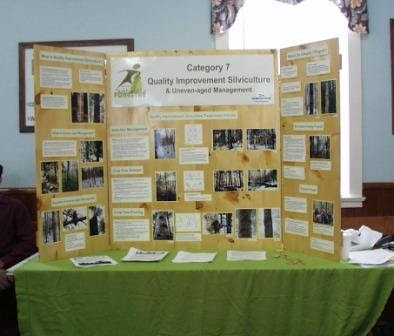
    Above, Registered Professional Forester Patricia Amero of Picea Forestry Consulting reports to the group on the success of the Outreach Project that the NSWOOA is conducting under a contract with the Association for Sustainable Forestry. Funding for this project is provided by the Nova Scotia Department of Natural Resource. Below, the Outreach Project has taken this display, hand-made by newly elected NSWOOA board member Sandy Hyde, to Woodlot Owner Conferences and other woodlot-owner meetings all over the province.


    Patricia Amero of Picea Forestry Consulting presented a report on the Uneven-Aged Management Outreach Project that Picea is doing together with the NSWOOA. She summarized the features of the program, and outlined accomplishments to date. The project seems to be going very well and is on schedule. There are already about 250 woodlot owners in the database and more taking the survey every day. Read about the educational sessions below. Space is limited and pre-registration is required, so get in touch with the Outreach Project soon if you want to attend.


    Above, NSWOOA Director Austin Parsons takes notes during his presentation on the Board's proposed submission to Voluntary Planning.

    Director Austin Parsons presented the Board's proposed Voluntary Planning submission. It was in four parts. The first discussed forest diversity and healthy ecosystems as the basis of a diversified forest product industry. Diversity means sustainability and flexibility, whereas one product means rigidity and lack of sustainability. The second part dealt with the need for simplification and standardization in the industry. It would be much easier if all mills described their specifications in the same terms, and used the same criteria and paperwork for their Registered Buyer funds. The third section dealt with viewing woodlot owners as entrepreneurs who manage legitimate businesses. How can the business owners gain control of the resource? The final section was the recommendations and actions needed to bring about desired change.
    Comments were vigorous and extremely helpful to the Board for their final revision. The presentation drew many compliments from those attending.

    Lunch was followed by a lively panel discussion of "Hot Topics" such as Acadian Forest Restoration, biomass production, and global climate change. Below, NSWOOA President Lorne Burrows and Past President Tom Miller were among those who spoke during this discussion.


    Lorne Burrows

    Tom Miller


    Cause to Celebrate

    Three new directors were chosen for the NSWOOA board at the AGM: Tony Phillips, Sandy Hyde, and Kermit DeGooyer. Congratulations and welcome aboard.

    Category 7 Outreach Project

    Our Uneven-Aged Management Outreach Project will be conducting workshops and field trips throughout the province in May and June.

    Focused on selection management, crop tree release, and crop tree pruning (silviculture methods that help woodlot owners to grow high-value trees), these free workshops are scheduled as follows:
    • May 3, Digby County, Richfield area
    • May 10, Colchester County, Earltown area
    • May 24, Queens County, North Brookfield area
    • June 7, Victoria County, Middle River area
    • June 14, Antigonish County, St. Joseph area

    Space for the Uneven-Aged Management Project workshops is limited, and pre-registration is required. To register, please call 902-673-2278 or email outreach@asforestry.com

    Old Fields

    An excerpt from Jamie Simpson's new book Restoring the Acadian Forest, p. 93. Used with permission.
    Years of agricultural use typically have changed the soil composition and structure of [old fields]…. Some sites have a soil condition known as hardpan, caused by decades of ploughing to the same depth and which limits proper drainage and rooting. Course woody debris and, in some cases, nutrients and organic soil matter are even lower than in recent clearcuts. Plants common in abandoned fields—known as pioneer species—are able to withstand poor conditions, so they play an important role in rejuvenating such sites. With time, fields that are not mowed will eventually fill with pioneer species. The early successional plants protect the soil from erosion, add nutrients, and build organic matter. They also add shade and increase moisture levels, creating suitable microclimates for later-successional species and providing food and nesting sites for wildlife. Many of the pioneer trees grow fast and haverelatively short lives, so they provide a relatively quick source of standing and fallen deadwood. White spruce is a common component in this succession, along with species such as tamarack, white birch, poplar, cherry, alder and willow.
    Lines of Communication

    Members are encouraged to contact the Board of Directors, the Executive and other members through our email address (nswooa@gmail.com) or by phone (902-633-2108 or, for member services, 902-673-3009). Please feel free to use these methods to keep us informed of what is going on in your woodlot or in your community or area. We try to keep you informed through these updates, newsletters and mail outs, our column in Atlantic Forestry Review, the Annual General Meeting, and this website.

    NSWOOA Update, May 2007

    This update can be emailed to NSWOOA members who request it.

    Hello, woodlot owners,

    This is a busy time for the directors of the NSWOOA, but we are trying a new project,
    to communicate with members, through this update for those on line.

    New address. For those who would like to communicate with the Directors, to communicate ideas and concerns, to give input or ask questions, our email address is now nswooa@gmail.com

    Annual General Meeting April 14. It was good to see many of you at the annual meeting. This year we were focusing on practical advice, especially for those beginning to manage their woodlots, but for experienced folk too. We will miss the contributions of Will Martin and Adam Campbell from the Board, but welcome Austin Parsons aboard. Minga O’Brien updated us on our involvement with Ecology Action Center’s Standing Tall Campaign which we joined at last year’s annual meeting. Presentations were made on management plans, sustainable forest funds, how Group Savoie distributes silviculture funds, progress on the restoration handbook being prepared by the North Mountain Old Forest Society, and much more.

    Help wanted. The Board is searching for a woodlot owner who can offer help by taking over management of our website, nswooa.ca. The site is visited by news organizations and prospective members, as well as members looking for news and events. Frequent updates of information, changing pictures, adding pages and features would be involved. A vibrant web site is Important to our growth and influence. If you can help or know someone who can, respond to the above address.

    Opportunity knocks. The Board is offering a $1000 incentive to any member (or woodlot owner willing to become a member) to host our annual woodlot tour and demonstration day. You can nominate yourself or a friend. The successful woodlot may have some interesting work done, or it may be the right woodlot because nothing has been done, and we can discuss how to get started. Time is an important factor here; act today.

    We are also contemplating workshop style events at the field day. Participants might for example spend a whole morning pruning trees, or learning to select which trees to harvest. Let us know your preferences.

    Brown Spruce Longhorn Beetle. The only resolution from the membership at the annual meeting directed the Board to represent the rights and welfare of woodlot owners under the new regulations for containment of the BSLB. Of particular concern to the Board is the inflammatory language used to describe the beetle and its possible impact. The fear of utter devastation could possibly lead landowners to rashly agreeing to have their woodlots stripped. The more advisable course is to assess the real damage and potential risks on your woodlots, and to make plans to deal with these areas. If you are unskilled at management planning yourself, getting the advice of a forester or management planner who uses multiple techniques to manage the forest and to keep the forest structure as intact as possible is advised.

    Seeking Input. Have you heard talk about biomass harvesting? Cogeneration? The NSWOOA is preparing to represent woodlot owners on these and other issues, and it is helpful to have your input. Is it a good idea? Can the allowable cut for NS support another market? What restrictions should reasonably be put on this market? The NSWOOA expects to be making presentations to the forest strategy hearings when they commence, so give us your thoughts on this and other issues that need to be dealt with.

    Pay the Piper. Membership fees are the only source of income for our Association. By oversight, the membership renewal form was omitted from the pre Annual meeting mail out. If you also had an oversight and forgot to renew your 2007 membership, please send it in to our mail box:
    NSWOOA
    P.O. Box 823
    Truro, N.S. B2N 5G6